Every winter a handful of guests tell us they nearly canceled because they read something alarming about driving in the mountains. So here is the version from people who make these drives five months a year, in the dark, after storms, with the plow somewhere ahead of us or somewhere behind. The short of it is that the roads up here are better than their reputation, the weather is worse than the forecast, and a little preparation is the whole game. What follows is what we tell guests who ask, from the interstate that brings you to our door to the passes and back roads that behave very differently once the snow starts.
The roads are mostly fine
I-93 runs straight to Lincoln and is a maintained interstate the entire way up from Boston and Manchester. In an ordinary snow week the drive is unremarkable. The New Hampshire Department of Transportation plows and salts the interstate around the clock through a storm, so the surface you meet is usually wet or slushy rather than glazed. What changes as you climb is the margin. Storms arrive faster up here than they do on the coast, the road can go from wet to slick in a few miles of gaining elevation, and in a heavy squall the plow might be 20 min behind the snow instead of in front of it.
It helps to know the shape of the drive from the south. The first stretch out of the Boston area and past Concord is flat, fast, and no different from any other winter highway. The climb really begins north of Plymouth, where the road starts gaining elevation and the snowbanks along the shoulder get taller. By the time you reach Lincoln you have done most of the climbing, and the last couple of exits are straightforward. If conditions are going to deteriorate, that middle climb is where you will feel it first, so that is the stretch to slow down for and to stop chasing your planned arrival time.
None of that should put you off the trip. It just means the drive rewards leaving early and slowing down. The most useful habit is to drive the conditions in front of you rather than the speed limit or the schedule in your head. Double your following distance, brake gently and early, and treat bridges and shaded dips as the first places to ice. Do that, and the mountains stop being a problem and go back to being the reason you came.
One seasonal quirk worth planning around is the Sunday-afternoon crawl heading south on I-93. On a good ski weekend the whole valley points back toward Boston at once, and the single-lane sections through the notch can back up for miles from mid-afternoon on. If you are leaving on a Sunday, either get an early start or have a late lunch in town and let the worst of it pass; you will make better time and enjoy the drive a good deal more than you would idling in a line of brake lights.
Checking conditions before you leave
You can know what you are driving into before you turn the key. New Hampshire, Maine, and Vermont run a shared travel service you reach by dialing 511 from any phone, or at newengland511.org, with live cameras, current road conditions, and posted speed reductions during storms. When the state drops the interstate speed limit in a bad blow, it is worth honoring; those reductions track real conditions, not caution for its own sake.
The other thing to understand is that the Whites make their own weather. A valley forecast that reads clear can be a whiteout at the height of a pass, and a system that was supposed to arrive at midnight can show up at four in the afternoon. Check the forecast the morning you drive, not the day before you left home. If it is snowing hard, the right move is often to wait an hour for the plow to get ahead of it rather than to lead the storm up the hill. For the mountain side of the picture, our guide to trail conditions and mountain weather covers how quickly things shift once you gain elevation, which is the same reason a clear parking lot in town can sit under a squall a few miles north.
The car you want under you
Four-wheel and all-wheel drive help you get moving. Tires are what let you stop, and stopping is the part that keeps you out of trouble. If you are bringing your own car, decent tread depth is the single biggest thing you control, and a proper set of winter tires makes more difference on a cold, slick road than all-wheel drive on worn all-seasons does. The reason is the rubber as much as the tread: a true winter compound stays soft and grips in the cold, where an all-season hardens and skates. New Hampshire permits studded tires in winter if you want the extra bite on ice; plenty of locals skip the studs, run studless winter tires instead, and do fine.
If you are renting, ask for all-wheel drive and then check the tires in the lot before you pull out. Rental fleets in New England are not uniformly good about tread, and a set of bald all-seasons on an all-wheel-drive SUV is a worse winter car than a well-shod sedan. Nobody up here carries chains, and you will not need them; this is not that kind of mountain driving. What you want is grip and a calm right foot, in that order.
Two smaller points catch people out. Cold air lowers your tire pressure, so a warning light on the dash your first frigid morning here is usually the temperature, not a leak; bring the tires up to the door-jamb spec and move on. And all-wheel drive breeds false confidence, because the thing that gets you up to speed so easily does nothing to help you stop or turn on ice. The drivers we see in the ditch after a storm are rarely the cautious ones in modest cars; they are the ones who trusted a big SUV to do something no tire can.
What to keep in the car
Nothing exotic. A scraper and brush long enough to reach the middle of the roof, because the sheet of snow you leave up there becomes the next driver's windshield. Washer fluid rated for cold, because road spray in a New England thaw coats your glass in gray film and summer-weight fluid can freeze on contact. More gas than you think you need, since the stretches with services are farther apart than they look on a map. A phone cable, because cold drains a battery fast and you may be navigating longer than you planned.
Beyond that, keep a warm layer, a hat, and real boots in the car even if you are driving in sneakers, on the reasoning that the one time you are stopped on the shoulder for 20 min is the time you will want them. A small folding shovel and a bag of sand or a set of traction mats are good insurance if you have the room, though most winters you will never touch them. The goal is simply to be the driver who is fine when the drive takes longer than it should.
Black ice and the coldest hours
The hazard that catches visitors off guard is black ice. Deep snow you can see and slow down for; black ice you cannot, and that is what puts cars in the ditch. It forms where the road looks merely wet: on bridges and overpasses that lose heat from both sides, in the shaded dips where the winter sun never reaches, and on any low spot where meltwater ran across the pavement in the afternoon and froze after dark. The worst windows are the early morning before the sun and the salt have done their work, and the hour or two after sunset, when a wet road flips to ice as the temperature drops back through freezing.
If it rained or thawed during the day and the night is going cold, treat every dark, wet-looking patch as ice until proven otherwise, especially on bridges. The way through it is boring and it works: slow down before you reach a suspect stretch rather than on it, because braking or steering hard on ice only makes things worse. Ease off the gas, keep the wheel straight, and let the car coast across. If you do start to slide, look and steer where you want to go and stay off the brake until the tires bite again. None of this is dramatic in practice; it is mostly a matter of not being in a hurry at the two ends of the day when the road is quietly at its most slippery.
Driving through Franconia Notch
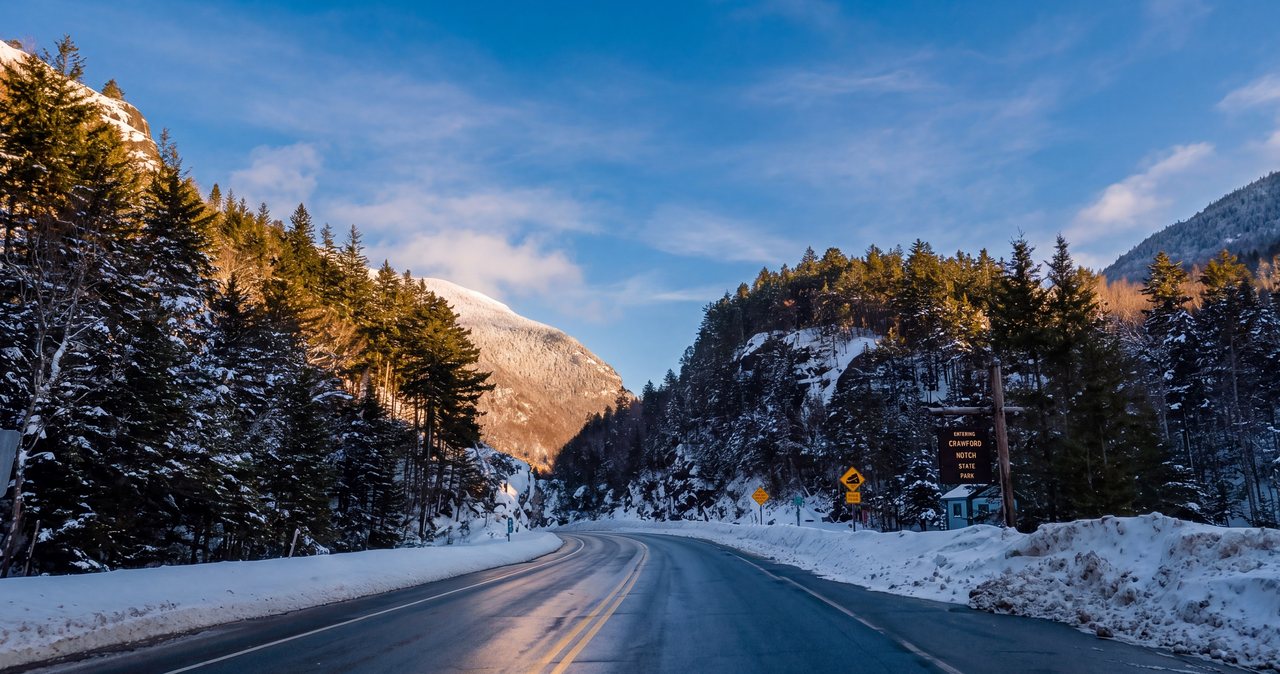
North of Lincoln, I-93 narrows into the Franconia Notch Parkway, a stretch so unusual it took a special act of Congress to build it as it stands: a single lane in each direction, threading a mountain pass, with essentially no breakdown shoulder. It is the prettiest few miles of interstate in the state and the one that asks the most of you in weather. From roughly November into April this corridor sees hard snow and ice, with steep mountain walls rising right off the pavement, and there is nowhere legal or safe to pull over and wait a storm out once you are in it. Stopping on the interstate here is prohibited for good reason.
The practical rule follows from the shape of the road. If the weather is turning and you are still south of the notch, wait it out in Lincoln rather than committing to the pass. The town has coffee, warm rooms, and a fireplace, and the parkway will still be there in an hour once the plow has run. If you are already in it when it gets bad, keep your speed down, leave a long gap to the car ahead, and stay off the brakes on the descents. Our overview of Franconia Notch State Park lays out what sits along that corridor, most of which you will want to see in daylight and decent weather anyway.
Roads that close for the winter
A few local roads simply shut down once the snow flies, and every winter somebody plans a loop around one and finds a locked gate. Bear Notch Road, the connector between the Kancamagus Highway and Route 302 in Bartlett, is not maintained in winter; the town gates and locks it at both ends and it becomes a groomed snowmobile trail until spring. Tripoli Road, the back way between Woodstock and Waterville Valley, is the same story, unplowed and gated through the cold months, with its western end off I-93 closed from roughly November into May.
Seasonal attractions close too. The Flume Gorge, the state park's boardwalk gorge walk, runs on a timed-entry season that ends in late October and does not reopen until spring, so it is off the table for a winter visit no matter how clear the day. The lesson is to check before you build a day around a specific road or gate. If a route looks like a clever shortcut on the map and you have not confirmed it is open, assume it is snowed shut and plan the long way instead.
The Kancamagus in winter
The Kancamagus Highway starts at the eastern edge of Lincoln and stays open and plowed through the winter, which surprises people. What does not change is what the road lacks: across its 34 miles to Conway there is no gas, no food, no shops, and no cell signal, and the height of land tops out around 2,855 feet where the weather runs a notch harsher than in town. That combination is fine on a clear winter day with a full tank, and no place to be in a bad one.
If you want to drive it in winter, and it is a beautiful drive, treat it with respect. Fill the tank in town first. Do not attempt it while it is actively snowing; wait for a clear window. Download your maps before you leave, because there is no signal to reload them out there, and tell someone your plan. Coming from the Conway end, the Forest Service's Saco Ranger Station just off the highway is the place to ask about current conditions. You do not have to drive the whole thing; the first several miles out of Lincoln show you plenty and let you turn back easily. We keep a short answer to the common question on file at is the Kancamagus open in winter, and our note on cell service and what to download covers exactly which offline maps to grab before you lose signal.
Getting to the trailheads and ski hills
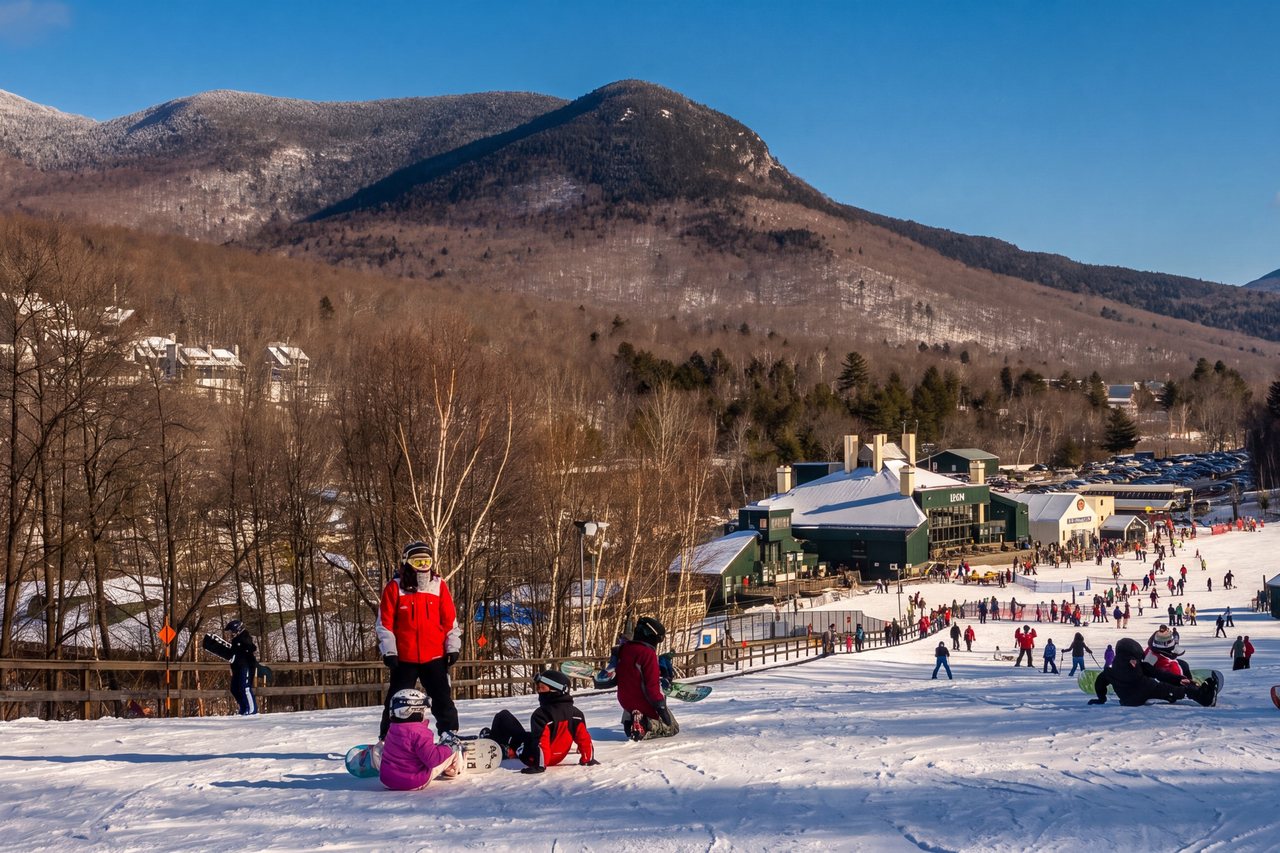
Most winter driving here is short: 10 or 15 min to a trailhead, a ski hill, or a scenic pull-off. Trailhead lots in the White Mountain National Forest require a parking pass, five dollars for a day or thirty for the year, displayed on the dash, and the fee holds in winter. Some lots are plowed and some are not, so if you pull into an unplowed one, do not bury your car in a snowbank you cannot back out of. Loon Mountain sits about 6 min east of us and is the easiest ski drive in the area; its lot is plowed and busy on weekends, so arrive early.
You can buy the national forest pass online, at the ranger stations, or from the self-serve kiosks at many of the larger trailhead lots, so a missing pass is easy to fix on the way. If Waterville Valley is your destination, note that you reach it on the plowed state road off I-93, not on the gated Tripoli back road, so it stays accessible all winter even though its scenic connector does not.
One planning note for the Franconia Notch side. The Cannon Mountain aerial tramway has been retired since the fall of 2025 and no reopening date has been announced, so there is no driving up to ride it to the summit for a winter view right now. The Cannon ski area itself still operates as usual; it is only the tram that is out. Plan your drive around the lifts and the lodge, not the tramway, and you will not be caught out.
Wildlife and driving after dark
Winter nights are long here, which means a lot of your driving happens in the dark, and the animal to respect is the moose. They are tall, dark, and slow to react, their eyes do not reflect headlights the way a deer's do, and a collision with one is a serious matter because the body sits at windshield height. They move most at dusk and dawn, and the shoulder weeks on either end of deep winter are the riskiest. On the darker roads, the Kancamagus, the notch parkway, the back roads out toward Easton and Sugar Hill, keep your speed down at night, use your high beams where you can, and scan the edges of the road rather than just the centerline.
Deer are common too, and where you see one, slow down, because there is usually another behind it. The same advice applies to the four-legged version of black ice: assume the thing you cannot see is there. If an animal is in the road, brake straight and hard rather than swerving, since leaving your lane on a snowy mountain road is often the greater danger. It does not come up often, and it should not keep anyone home. It is the reason we tell guests to take the dark drives slowly and skip the temptation to make up lost time after sundown.
Parking and getting to our door
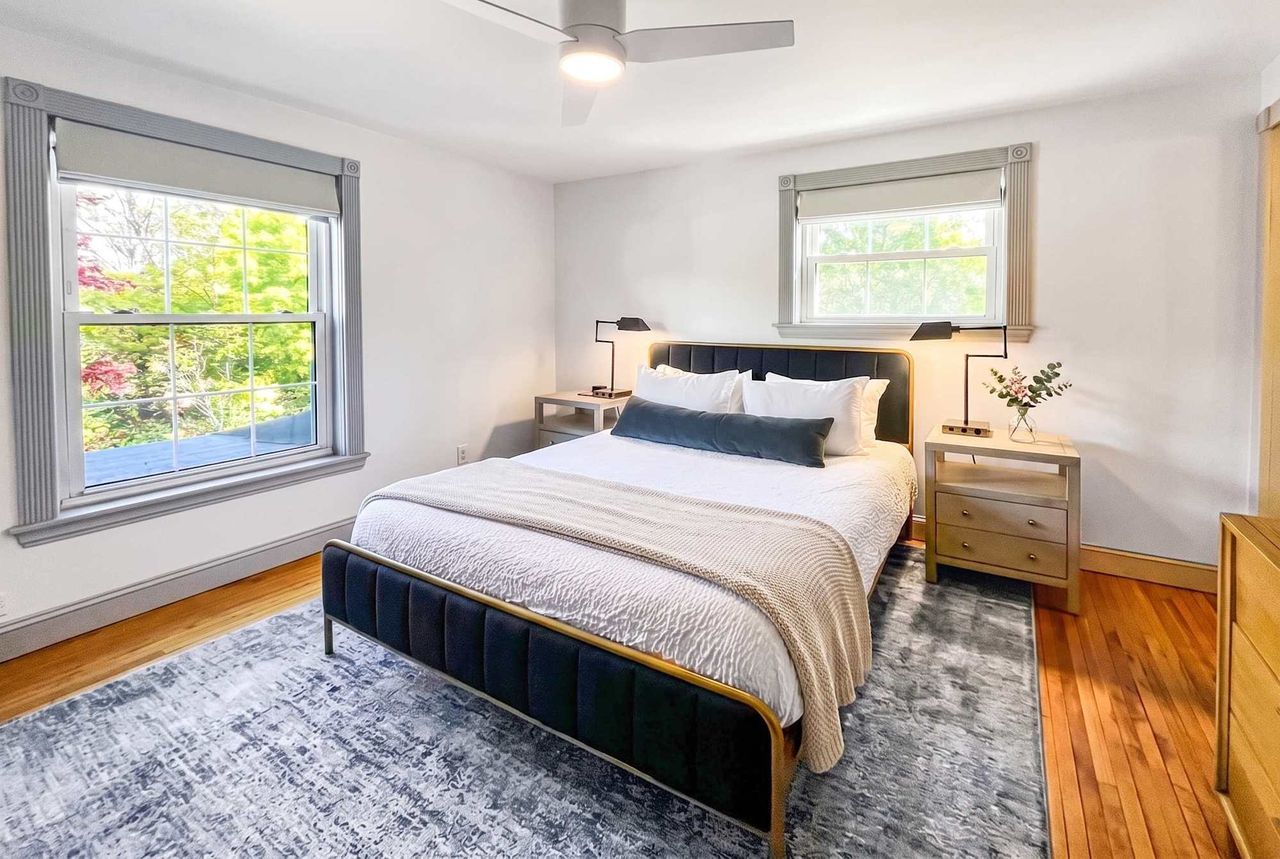
Parking at the lodge is free and off the road, so you are never moving your car for a plow at six in the morning, and you are not circling a lot in the cold looking for a spot. Our keyless self check-in matters more in winter than in any other season: your door code works the moment you arrive, so if the weather turns a four-hour drive into six, nothing is lost and nobody is waiting up. That is the main reason we run check-in the way we do, and if you want the details, how self check-in works walks through it.
Two small things for the walk from the car to the red door. It is short, but it is still New Hampshire in January, so bring shoes you can cross a bit of packed snow in rather than changing out of driving slippers in the dark. And if you are in an electric car, know that cold weather noticeably shortens range and slows charging, so arrive with more buffer than you would in summer; there are public chargers in town, and we are glad to point you to the nearest ones.
If you're flying in
The closest airport is Manchester-Boston Regional, roughly 90 min and under a hundred miles south on I-93, and it is the calmer arrival by a wide margin. Boston Logan is the bigger airport with more flights, about two to two and a quarter hours and a hundred and thirty miles away, straight up I-93 North to Exit 32 for Lincoln, with a single toll around two dollars at Hooksett on the way. Either way the drive is simple in daylight and tiring in the dark after a flight.
If you can, give yourself daylight on the last leg. There is no version of this trip that is improved by arriving frazzled at midnight after a delayed flight and a snowy notch in the dark. If you do land late, come anyway; the code works, the heat is on, and the mountains will still be there in the morning. For turn-by-turn help and the airport comparison in more detail, our guide on getting here to Lincoln lays out the routes from each direction.
If a storm lands during your stay
Sooner or later a real storm will land on a day you meant to be out driving, and the move is to let it. A blocked afternoon in Lincoln is a good afternoon. The town has coffee, shops within a short walk, and a brewery (Basecamp Brewing), and the lodge has a fireplace and quiet, mostly TV-free suites, so nothing keeps you inside longer than the sky requires. Wait for the plow and the clearing, then head out when the roads have caught up, rather than leading the storm up a pass.
This is where booking direct with us pays off in a practical way, beyond the best rate: reach us with any question about conditions and we will tell you plainly whether it is a stay-in day or a go day, because we are watching the same sky and driving the same roads. Winter driving in the Whites rewards a little preparation, and once you have done that, most of it takes care of itself. The reward is a set of mountains at their quietest and most striking, with a warm room and a short walk waiting at the end of the drive.
— Launchpoint Lodge, From the lodge