The question every foliage guest asks us
Every September the phone starts ringing with a version of the same question. People do not ask whether the White Mountains are beautiful in the fall; they already know that. What they want to know is whether the leaves will be beautiful on the exact weekend they can get away. They have two nights of vacation, a long drive up from Boston or New York or Hartford, and one shot at the most photographed three weeks in the Northeast. The worry underneath the question is always the same: what if we come all this way and miss it?
We understand the worry, and we want to take some of the pressure out of it. Here is the reassuring part, the thing we tell everyone who calls. When you are staying inside the mountains rather than driving up for the day, missing the color is much harder than you think. Peak foliage is not a single afternoon that either happens while you are here or doesn't. It is a slow wave that rolls downhill for the better part of a month, and from a base in Lincoln you can almost always drive to meet it. If you are a little early, you go up. If you are a little late, you go down and south. The color is somewhere; the trick is knowing where to point the car.
That is really what this piece is about. Not a promise that any given weekend will be the postcard — no one can promise that, and anyone who does is guessing. It is about how the season actually behaves around Lincoln, how we help guests read it from the front porch, and how a few small habits turn a foliage trip from an anxious gamble into an easy, unhurried few days. We have watched this happen from the same address for years, and the pattern is remarkably dependable even when the dates shift.
How the color moves through the mountains
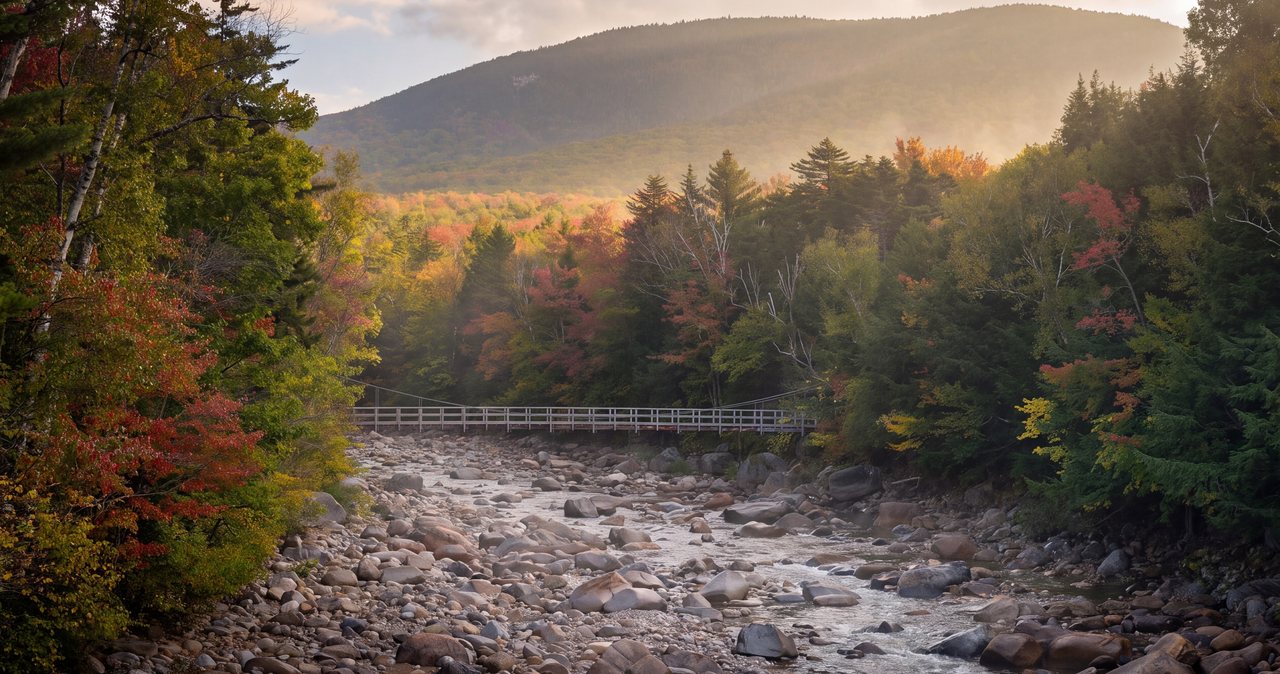
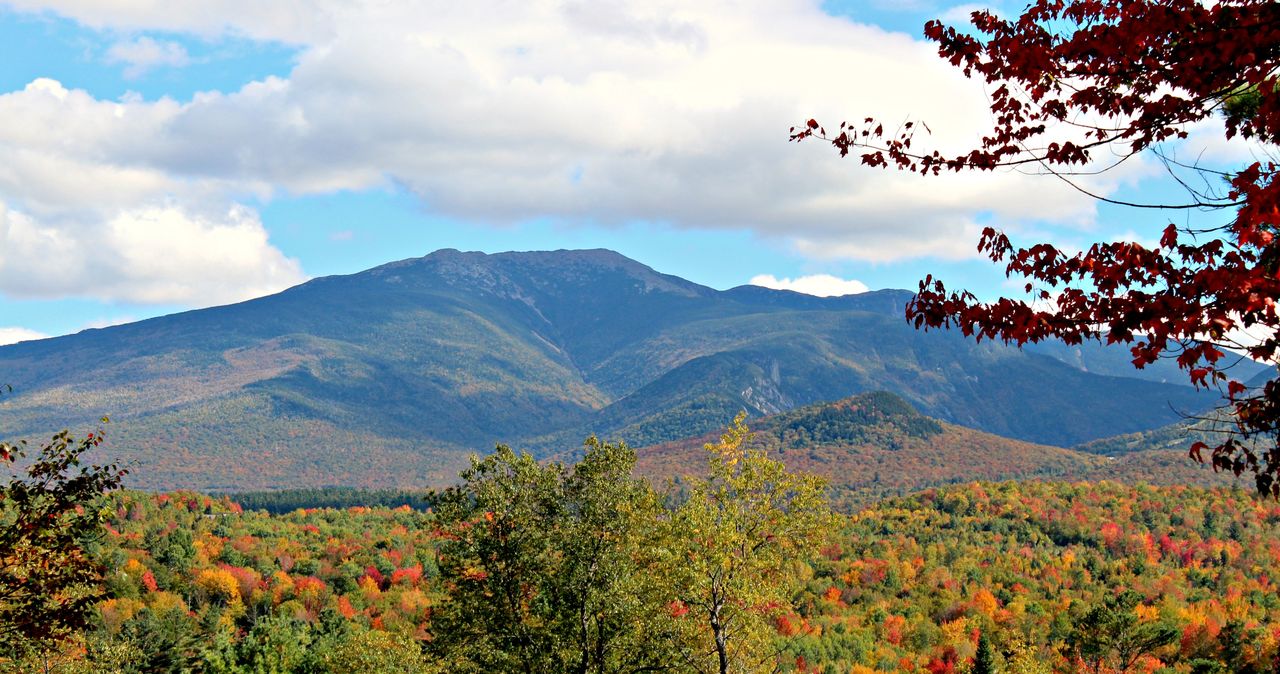
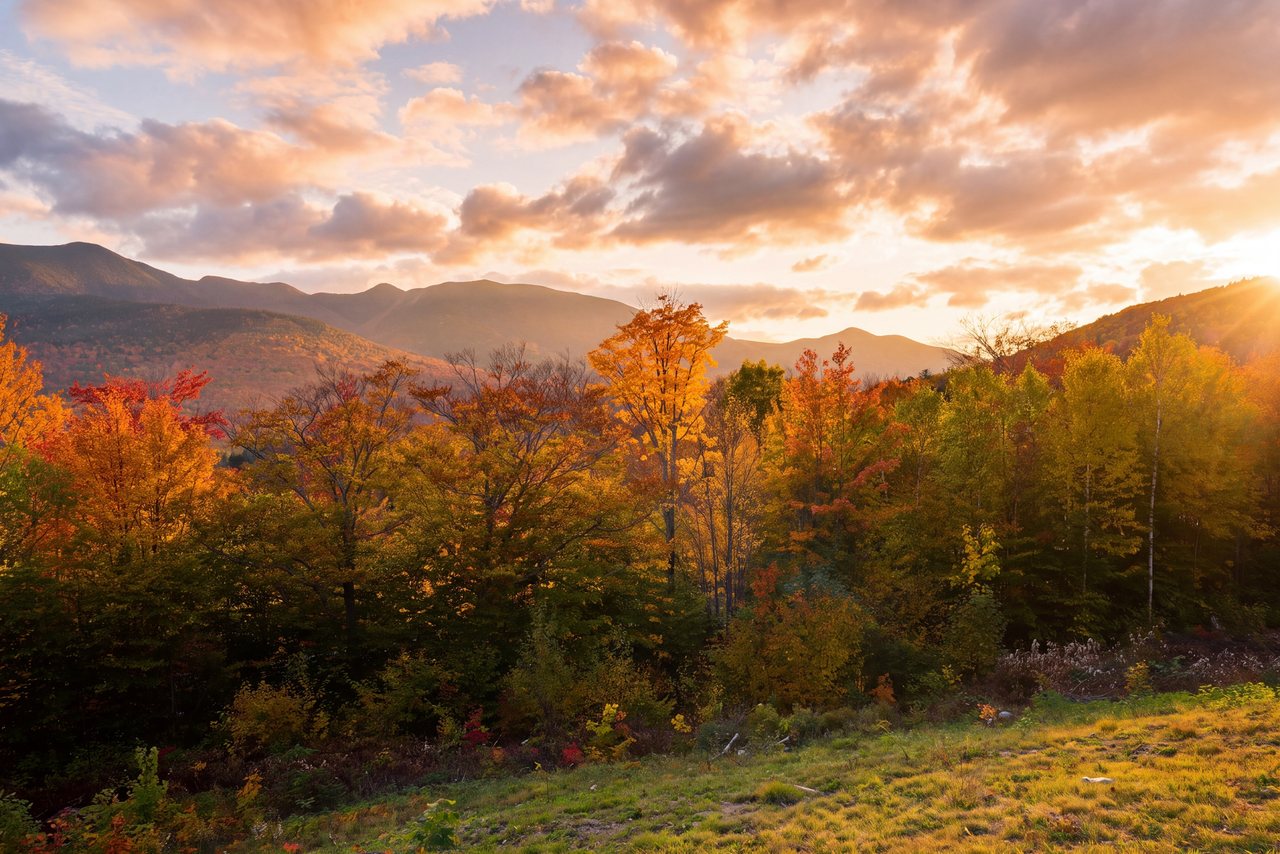
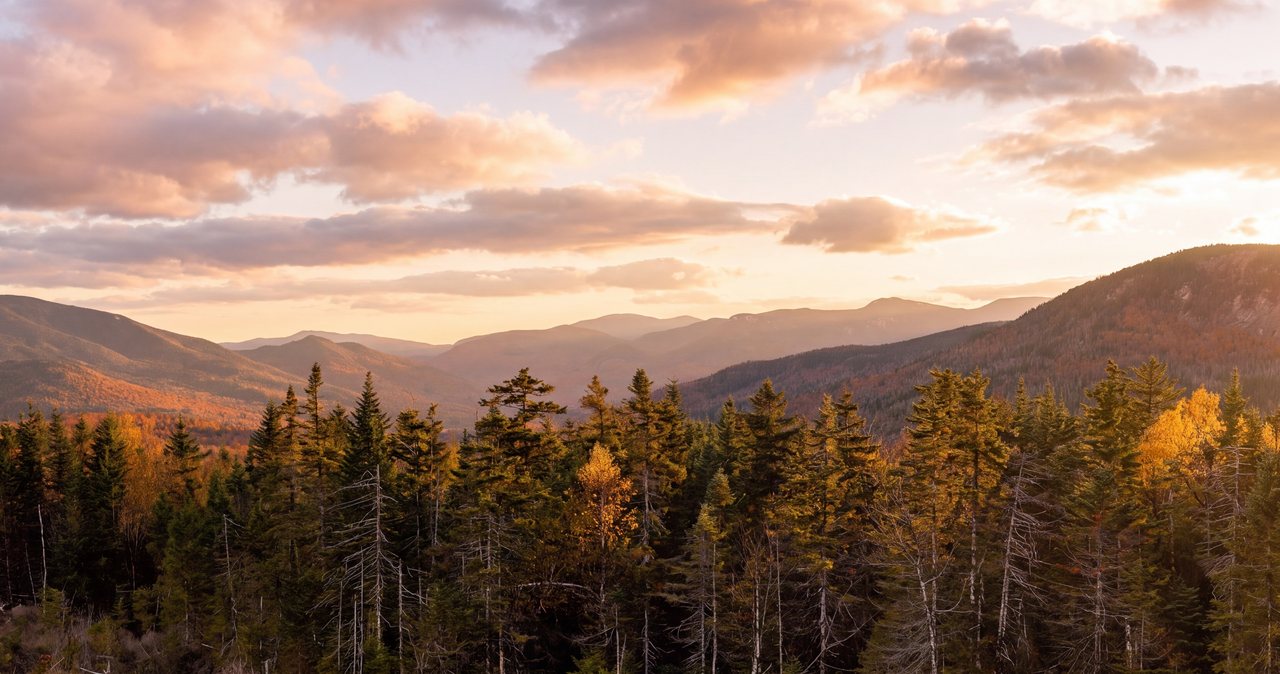
The single most useful thing to understand about fall in the White Mountains is that elevation runs the calendar. Cold arrives at the top of the mountains first and works its way down, and the leaves turn in the same order. So instead of one region-wide peak, you get a color line that starts high in the last days of September and walks down the slopes for about three weeks, reaching the valley floors around Lincoln in the second week of October.
It helps to think in three bands. The high band is everything above roughly twenty-five hundred feet — the exposed shoulders of the ridges, the mountain maples and the birches near the summits. That band shows its first real color in the last week of September, sometimes a touch earlier in a cold year. The middle band is the mid-slopes: the sides of the notches, the flanks along the Kancamagus Highway, the forest you look up into from the road. That band comes into its own around the first week of October. The low band is the valley floor where the town sits, the river corridors, the maples in people's yards. That is the last to turn, and it usually peaks in the second week of October.
It also helps to know what is turning, because the mountains do not change all at once or all in one shade. The most dramatic reds come from the maples — the red maples in the wet low ground and, above all, the sugar maples on the slopes, the trees that throw orange and scarlet in the same crown and give New England its reputation. The birches, beeches and poplars go yellow and gold and tend to hold a little longer, which is why a single hillside can read green, then red, then gold across three weeks as different trees take their turn. Up high the mountain ash and the low blueberry turn early and deep. The oaks down in the valley go last of all, to a slow russet bronze that carries a little color into November after everything else has let go. You are not watching one event; you are watching a relay.
Once you see the season this way, the anxiety eases considerably. The color is not a light switch. It is a tide coming in across the mountains, and on almost any day in the window there is a band of full color at some elevation within a short drive of the front door. A guest who arrives on the last day of September and thinks the valley looks green is not too early for the trip; they are simply looking at the wrong band. 20 min and a thousand feet up, the show has already started. We have laid the whole progression out week by week in our foliage tracker, which is the map we hand people who want the detail, and the longer fall foliage guide goes deeper still.
What each week of the season looks like
Because the color moves, each week of the season has its own character, and knowing which week you are booking tells you a lot about what you will see and how busy it will be.
The week around September twentieth is the opening act. Down in town everything is still summer-green, but the high shoulders of the Franconia Range have started to blush, and if you drive the parkway through Franconia Notch and look up at the ridgelines, you will see the first reds and golds sitting on top of the mountains like a dusting. This is a lovely, quiet, underrated week. The crowds have not arrived, the weather is often warm and stable, and the trails are still fully open. If you want the mountains mostly to yourselves with a preview of the color, this is a week worth booking on purpose.
The week around September twenty-seventh is when the high band hits its stride and the middle band begins to catch. The upper slopes across the notch and along the Kanc light up, and the color starts creeping down toward the road. Late September into the very first days of October is, for our money, one of the best all-around windows of the entire year: the bugs are long gone, the air is crisp, the summer families are back at school, and the color is coming in.
The week of October fourth is the safe middle. The middle band peaks, the valleys are beginning to turn, and you can find full color at almost any elevation. If you asked us to pick one week that balances beautiful leaves against manageable crowds, this is usually it.
The week of October eleventh is the classic postcard, and it is also the busiest few days of the entire mountain year. The valley floors around Lincoln peak, the river corridors go orange, and the mid-slopes are still lit above them, so you get color stacked from the road to the ridge. It is spectacular. It is also Indigenous Peoples' Day weekend — the holiday Monday falls on October twelfth in 2026 — which means lodging books out months ahead and the Kancamagus pullouts fill by mid-morning. If your heart is set on that week, book early and plan to be an early riser.
The week of October eighteenth is the fade, and it is better than its reputation. The valley color loosens and the ground starts to gild over, but the crowds thin out fast once the holiday passes, and a warm gold week with the mountains half-bare and quiet has a melancholy beauty all its own. It leans into what we call the shoulder season, which we have written a soft spot for in the two-night foliage plan and in our foliage diary.
Booking around a moving target
All of this raises the practical question: if you are booking blind in the spring or summer, before anyone knows what kind of autumn is coming, which week do you reserve?
If you want the single safest bet for full color in the valleys around town, book the week that contains the holiday — the week of October eleventh. That is the week most likely to give you the stacked-from-road-to-ridge postcard right outside the door, with the least driving required to find it. The cost of that safety is company: you will be sharing the mountains with a great many people, and you will want to be out early. It is a fair trade if the classic scene is what you came for.
If you would rather trade a little certainty for a lot more room, book the first week of October instead. You are one band early on the valley floor, which simply means you drive up to meet the color rather than stepping out into it, and the mountains feel far less crowded. Plenty of our guests who have done both prefer this week and never look back.
And if the calendar only gives you late September or the back half of October, take it without hesitation. The late-September traveler gets the high country in full cry and the valleys still green and open; the mid-to-late-October traveler gets the golden fade and elbow room. Neither is a consolation prize. The only truly hard week to love is a warm, windy, wet one that strips the leaves early, and no amount of advance planning can control the weather — which is exactly why we spend so much of this piece on how to adapt once you are here rather than on picking a perfect date you cannot pick. For the full month-by-month reasoning across every season, our best-time-to-visit guide is the one to read.
Chasing the color from the lodge door
Here is where staying inside the mountains pays off. From the lodge you are a few minutes from Interstate 93 at Exit 32, and from there three of the best foliage drives in New England open up in three different directions. That means whatever the color is doing on the morning you wake up, you can steer toward it instead of hoping it comes to you.
The Kancamagus Highway is the headline. It runs roughly thirty-five miles east from Lincoln over a pass and down to Conway, climbing through the middle band and topping out high enough to catch color early. Its whole length is free of gas stations, restaurants and shops, which is part of its charm, so fill the tank before you go. The overlooks near the height of land give you the layered-ridgeline view people picture when they picture New England in October, and Sabbaday Falls is an easy stop partway along. We say much more about how to take it slowly in our piece on driving the Kanc.
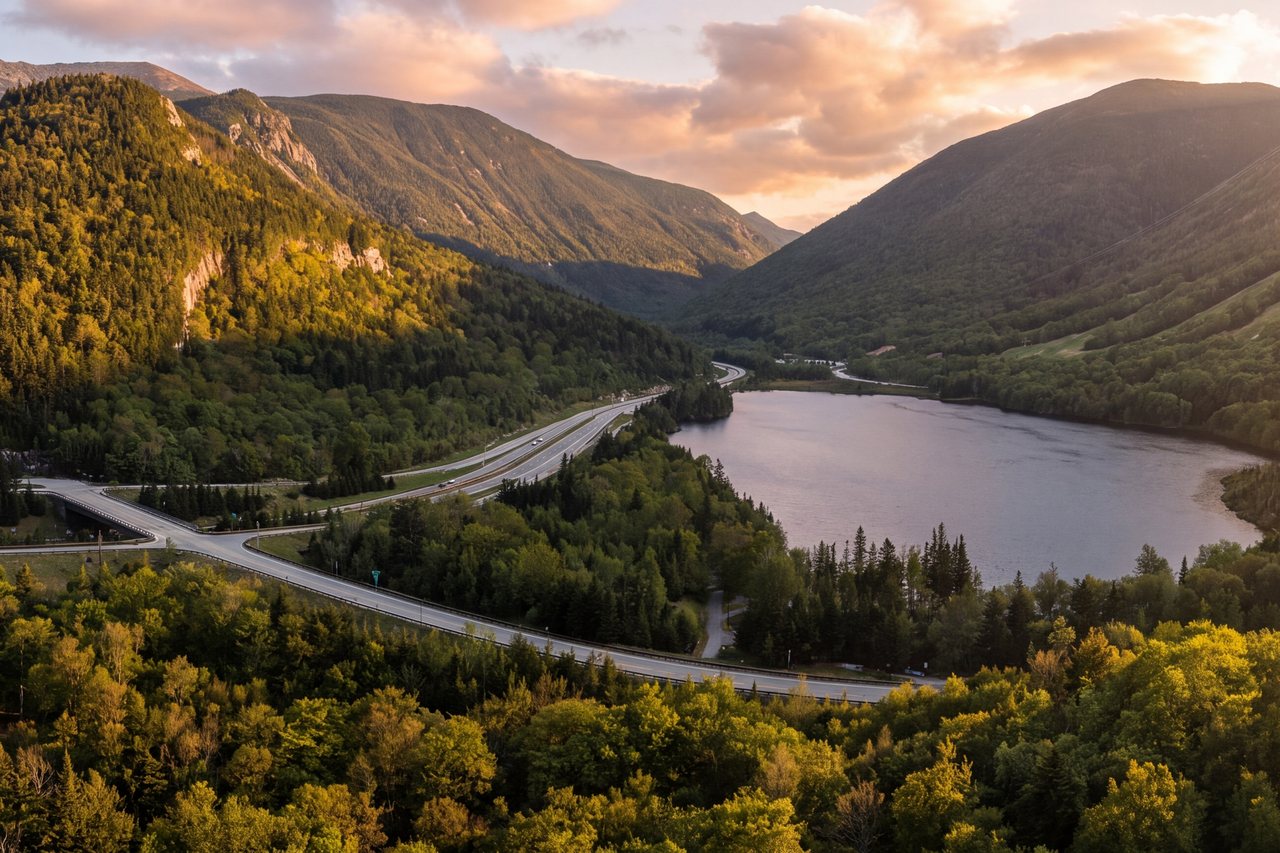
The Franconia Notch parkway is the second direction, and it is the one to choose when you are early in the season, because the notch walls rise fast and hold color up high before the valleys turn. The parkway threads between the cliffs past Echo Lake and the Basin, both of which give you water to double the color with a reflection. It is about 10 min from the lodge to the heart of the notch, which is the whole argument for basing here.
Bear Notch Road, off the Kancamagus near Bear Notch, is the local's third card — a quieter, curvier back way with its own overlooks. It closes for the winter, so it is a fall-and-summer pleasure only. When the valley is early and you want to get up into the middle band without the Kanc traffic, it is a fine choice. We have collected the full set of routes, with which to drive when, in our best foliage drives guide.
The one rule that ties them together: if the town looks green when you wake up, drive up. If the town is already past and dropping, drive down and south, where the color runs a few days behind. You are never more than a short drive from a band at full peak.
Seeing the leaves without a hike
Not everyone who comes for foliage wants to climb a mountain to see it, and you absolutely do not have to. Some of the best color of the whole trip is reachable from a car door or an easy stroll.
The simplest way to get high enough to look down onto the color, without any climbing at all, is the gondola at Loon Mountain, which is right in Lincoln. In the fall the gondola runs scenic rides up to the summit, carrying you nearly two thousand vertical feet into the White Mountain National Forest and setting you down at a view that takes in the whole valley. Dates and ticket details shift year to year, so it is worth checking ahead, but on a clear October day it is one of the easiest big views in the region. We point people to Loon specifically because the aerial tramway at Cannon Mountain made its final run in October 2025, and no reopening date has been announced for a new one — a lot of older guidebooks still send visitors to a lift that is not running, and we would rather you not make that drive for nothing.
Down at road level, the overlooks along the Kancamagus and the pull-offs in Franconia Notch do most of the work for you. Echo Lake gives you the color mirrored in still water with almost no walking. The Basin is a few minutes on a paved path to a granite pothole carved by meltwater, framed in foliage. If you want a slightly longer but still gentle leg-stretch, the short walks in the notch reward you far out of proportion to the effort. And if photography is the point of the trip, the way the light falls on all of this in the first and last hour of the day is its own subject — we wrote about where and when the light is best around Lincoln in a separate piece.
The traffic, and the dawn habit that beats it
We should be plain about the traffic, because we watch it every October from the porch. For about three weeks the same two-lane roads that carry a handful of hikers in July carry a slow river of out-of-state plates. The Kancamagus at midday on the holiday weekend can feel less like a scenic drive and more like a parking lot with a view. The Flume Gorge sells through its timed entries. The good pullouts fill and cars start nosing onto the shoulders.
There is one habit that beats all of it, and it is the reason staying in the mountains is worth so much more than driving up for the day: get out at first light. The day-trippers from the cities cannot leave home until morning and cannot arrive until mid-day, so the two or three hours after sunrise belong almost entirely to the people who slept up here. An overlook that is shoulder-to-shoulder at noon is often empty at seven, with the mist still lifting off the valley and the low sun setting the ridges on fire. You can be at a great view at first light and back at the lodge for a slow second coffee before the crowd from Boston has finished its first.
Because our check-in is keyless and self-service, you come and go on your own schedule — exactly what a dawn foliage habit needs. The other quiet window is the last hour before dark, when the day visitors have started the long drive home and the light goes gold again. Midday is when we suggest you do something indoors or in town: a long lunch, a brewery, a browse through the shops. Let the crowd have the middle of the day and take the beautiful edges of it for yourselves.
How we'd shape a single foliage day
People sometimes ask for an hour-by-hour plan, and we resist giving one, because the color and the weather should decide the day, not a printout. But there is a shape we recommend, and it works almost every time in the season.
Start in the dark. Coffee first, then drive out before sunrise toward whichever band is peaking — up the Kancamagus toward the height of land if the high country is on, into Franconia Notch toward Echo Lake if you want water and reflection. You want to be standing at the overlook as the sun clears the ridge, when the mist is still lifting off the valley and the pullout you are parked in would be full three hours later. Give it an hour. Watch the light move down the hillside. This first hour is usually the best hour of the whole day, and it is the one the day-trippers structurally cannot have.
Come back for a slow second coffee. Then spend the crowded middle of the day off the scenic roads entirely — a long lunch in town, an hour in the breweries or the shops, a scenic railroad trip that lets someone else navigate the traffic while you sit inside the color. Let the roads belong to the crowd from noon to about four.
Then take the day back for its second beautiful edge. As the afternoon tips toward evening the day visitors start the long drive home, the pullouts empty, and the light turns gold a second time. A short walk, a quiet drive, or a bench at an overlook is the reward. Finish with an unhurried dinner — and if you have booked the dinner train, that is your evening, color sliding past the window while the plates come out. Two beautiful edges, a comfortable middle, and none of it spent sitting in traffic. That is a foliage day done right, and from the lodge it is an easy one to run.
How the weather rewrites the week
No foliage plan survives contact with the weather, and it helps to know in advance how the weather can rewrite your week so a change of forecast feels like an adjustment rather than a ruined trip.
A hard wind and a soaking rain, especially together, will strip a peaking hillside in a day. If a big blow is coming through on the front of your stay, go see the color before it, not after — a peak that looked a week away can be knocked down overnight. On the other hand, a stretch of cold, clear nights and sunny days is what deepens the reds and holds the color longest, so a cold snap in the forecast is good news, not bad.
Overcast is the photographer's secret. A soft gray sky actually saturates the reds and oranges and softens the harsh shadows, so the leaves photograph richer on a cloudy morning than in hard noon sun. Do not write off a cloudy day; drive it. And an early frost, which is common up here by late September, does not hurt the show — it sharpens it.
If you arrive and the valley is well past — brown and thinning — the move is not to give up but to change elevation and latitude. The color that has left the valley floor is often still hanging on the north-facing mid-slopes and a little further up the Kanc, and it runs later as you go south. A "past peak" morning in town can still be a full-peak afternoon 20 min and a few hundred feet away. Because the mountains run their own weather, we check the higher-summits forecast, not just the town forecast, before sending anyone up high; our trail conditions and mountain weather guide explains how to read it.
A few short walks worth pulling over for
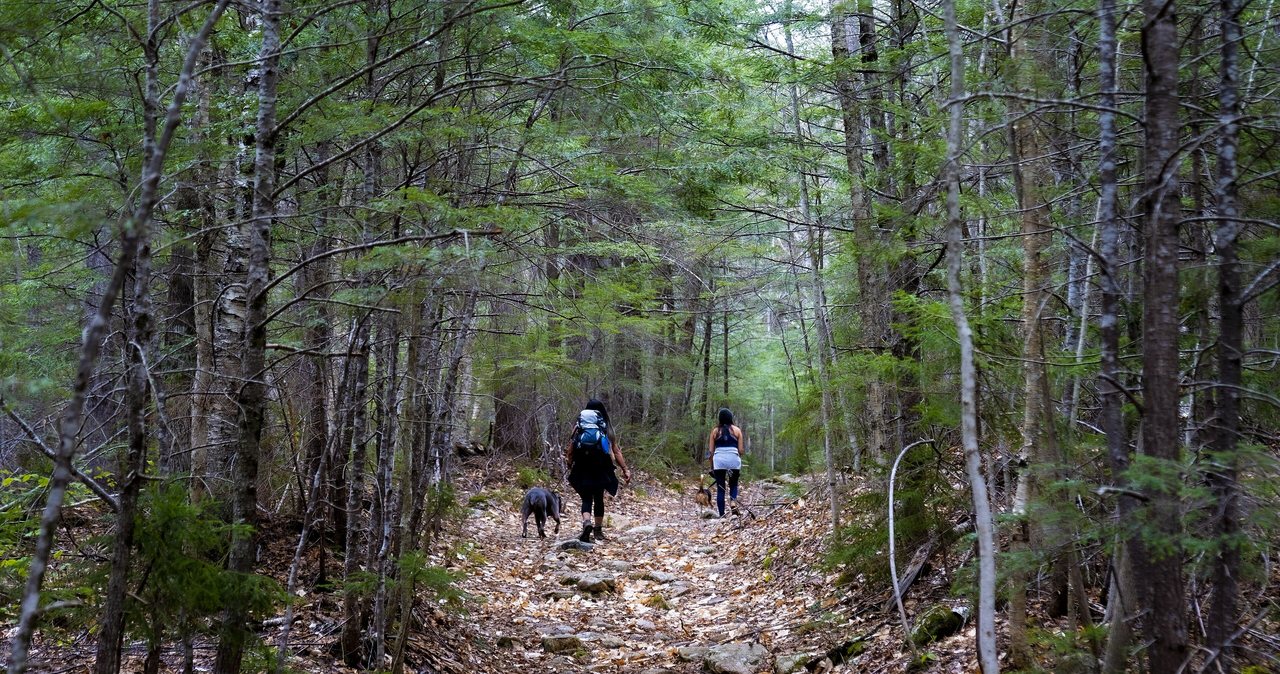
If you would like to put a little dirt under your boots without committing to a big hike, a handful of short legs around Lincoln pay off beautifully in foliage season, and none of them will eat your whole day.
Artist Bluff, at the north end of Franconia Notch, is the classic. A short, steep loop delivers you to a rocky perch looking straight down the notch over Echo Lake, and in October the view from the top is the one that ends up framed on people's walls. It is popular for good reason, which is another argument for going early.
Lonesome Lake is a steadier climb to a mountain pond that mirrors the Franconia Ridge, and the color reflected off the water on a still morning is worth every step. Sabbaday Falls, off the Kancamagus, is barely a walk at all — a flat, easy path to a tiered cascade running through a slot in the rock, framed by turning trees. And the gentle paths around Echo Lake and the Basin give you water, granite and color for almost no effort.
The point of these is not to conquer anything. It is to slow the trip down, get off the crowded road for an hour, and stand somewhere quiet where the only sound is leaves. Bring layers — a bright, still morning up high can be near freezing before the sun clears the ridge, and warm to shirtsleeves by lunch.
The rest of what fall brings to Lincoln
Leaves are the headline, but they are not the whole season, and some of our favorite fall days barely involve looking up at a hillside at all.
Mid-September brings the New Hampshire Highland Games to Loon Mountain, a large, lively weekend of Scottish athletics, music and food right here in Lincoln, timed to the very start of the color. It is one of the biggest gatherings of its kind in the country and a good reason to come a little before peak. We keep the current dates and the rest of the season's gatherings in our annual events guide.
The valley's two scenic railroads run their fall trips through the season, and they are a lovely low-effort way to sit inside the color while someone else does the driving. The Granite State Railway, right in town, runs its harvest-season trips along the Pemigewasset River from mid-September into October. For a more grown-up evening, the Café Lafayette Dinner Train in neighboring North Woodstock serves a long, unhurried dinner in restored vintage cars as the valley slides by outside the window, and it runs into late October — a fine capstone to a foliage day.
Fall is also simply the best eating-and-drinking season up here. The kitchens lean into it, the breweries pour their autumn beers, and a long lunch or an early dinner is the perfect way to spend the crowded middle of the day; our where-to-eat guide is the shortcut. One practical note for late-October visitors: Flume Gorge closes for the season in the last week of the month, so if the gorge is on your list, come before it shuts. The bugs, meanwhile, are a distant summer memory, and the trails that were busy and buggy in July are crisp and clear.
Down in the valleys it is harvest season, and that is its own small pleasure. The farm stands fill with apples and cider and squash, pumpkins line the roadsides, and the first hard frosts by the end of September put a bite in the evening air that makes switching on the fireplace worth doing. The days shorten quickly up here — you notice it more than you would at home — so an afternoon plan that felt open and lazy in summer wants an earlier start in October, with the light gone by half past six. It is all part of what makes the season feel so distinct: shorter, cooler and sharper than the rest of the year, and more beautiful for it.
Checking the color before you drive up
In the days before you leave home, you do not have to guess. New Hampshire publishes an official foliage tracker every fall from the middle of September, with weekly reports on where the color stands region by region, and it is the closest thing there is to a live GPS for the season. We fold that reporting, plus what we can see with our own eyes from the porch, into our week-by-week tracker, which we update through the season so you can see how a typical year unfolds and where the current one sits against it.
When you do check, read it through the elevation lens from earlier. A report that says the valleys are "just starting" while the high country is "at peak" is not telling you to stay home; it is telling you to drive up when you arrive. A report that says the valleys are "past" is telling you to drive down and south. The single number people want — a date for "peak" — does not exist as a single number, and once you stop looking for it and start reading the bands, the whole season gets much easier to plan around.
And when you are unsure, call us. A real person answers the phone at the lodge, and in early October there is a decent chance that person walked an overlook that same morning. We would rather spend 5 min on the phone telling you the color is still a few days out and you should shift your reservation than have you drive four hours to green trees. That is the kind of thing a small inn can do that a booking website cannot.
Why the lodge makes an easy foliage base
Everything above comes back to one advantage: where you sleep. A foliage trip run out of a hotel an hour south of the mountains is a series of long day-drives into traffic. The same trip run from inside the mountains is a set of short, early, unhurried outings with a comfortable place to come back to in between.
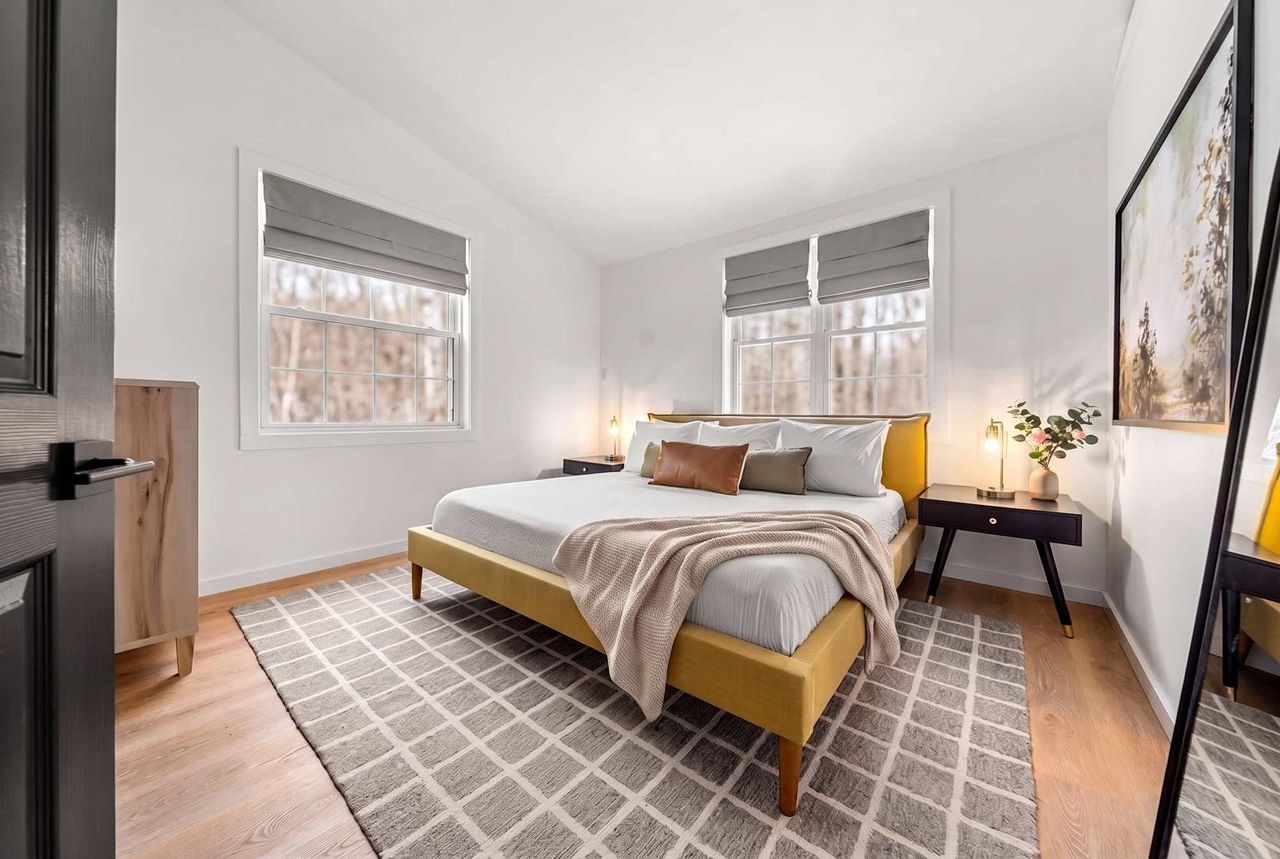
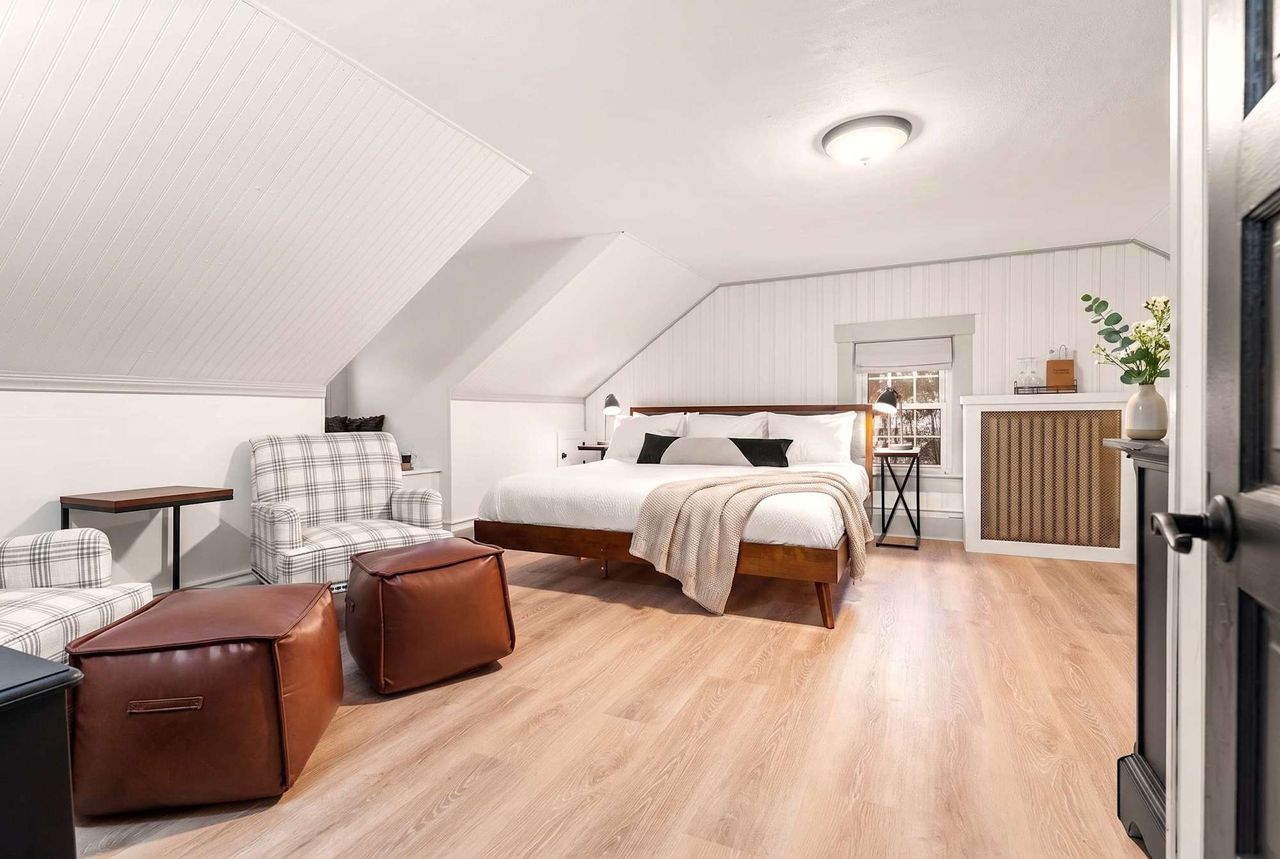
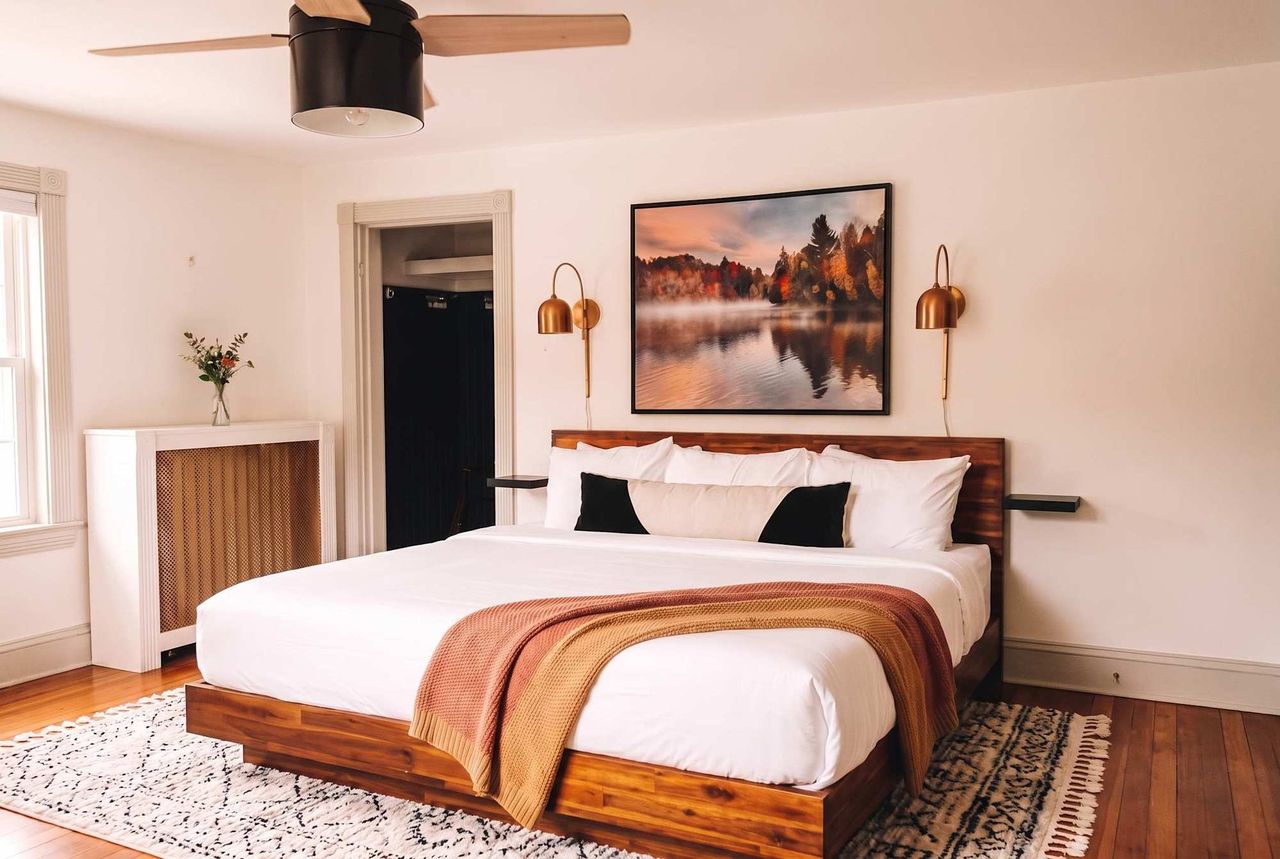
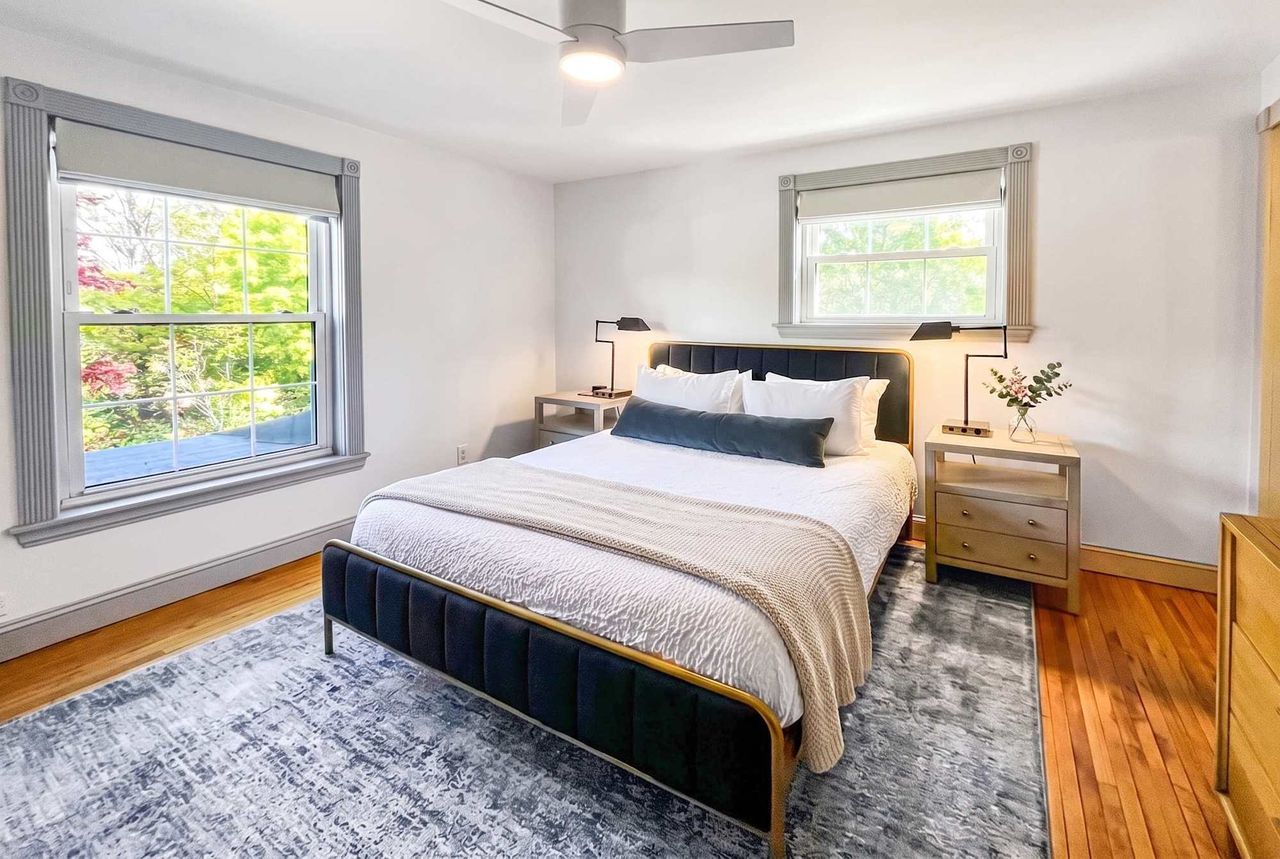
Launchpoint Lodge is a restored 1902 colonial in Lincoln with six suites, and it is built for exactly this kind of stay. We are 5 min from Exit 32 on Interstate 93 and about 10 min from the heart of Franconia Notch, so the drives in this piece start almost at the front door and the dawn overlooks are reachable before breakfast. Check-in is keyless and self-service, which means your foliage schedule is your own — up before dawn, back late from a dinner train, always on your terms. The lodge is adults-only, so autumn mornings here are quiet ones, and five of the six suites have no television, which sounds like a small thing until you spend an October evening reading by a window instead of scrolling. It is the kind of base that lets the mountains, not the logistics, be the trip.
If you are starting to sketch a foliage getaway, the fall foliage guide and the two-night plan will help you shape the days, the map shows you how close everything sits, and you can check dates and book whenever you are ready. Come for the leaves. Stay for the quiet mornings. We will point you toward the color.
— Launchpoint Lodge, From the lodge