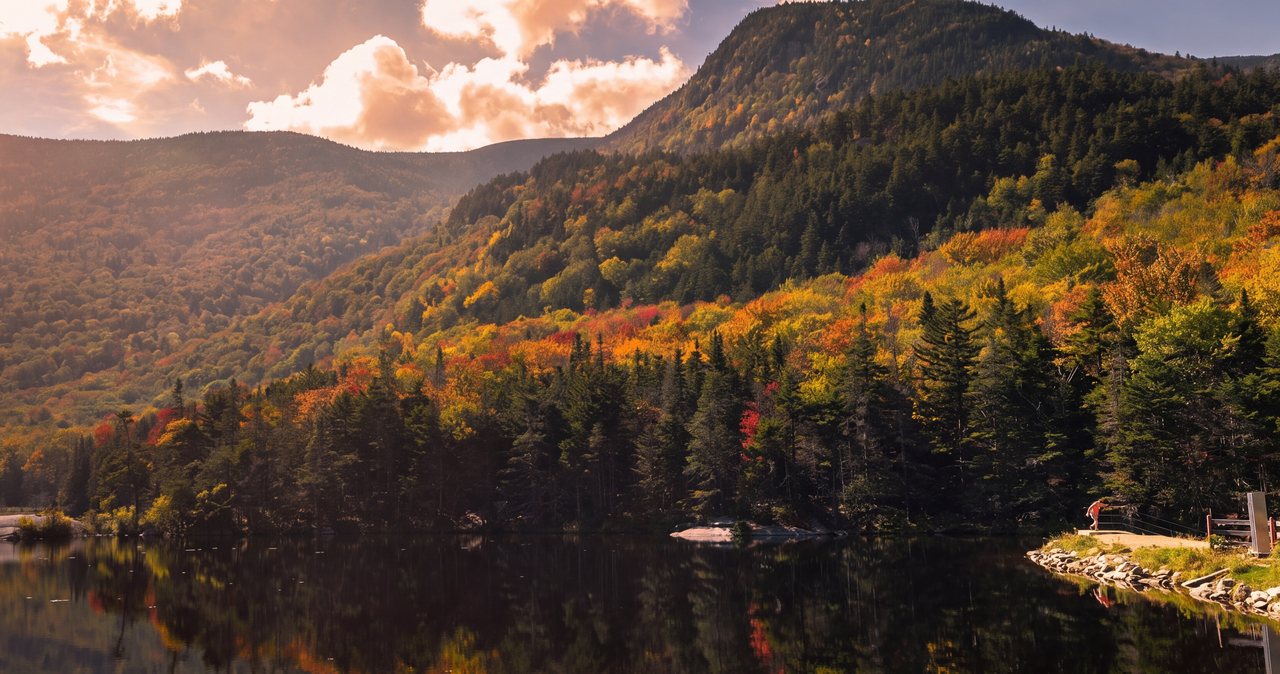
It is one of the first questions we get, often before a guest has finished finding the light switches: where can we see a moose? The lodge sits close to the trailheads, so we understand the pull. The moose is the animal people picture when they picture the North Woods, and the White Mountains are one of the few places in the Lower 48 where you have a real shot at one from the driver's seat. What follows is what we actually tell people who ask: when to go out, where to look, why the animals come down to the roads at all, and the part that matters more than the sighting, which is getting home without a moose coming through your windshield.
Nobody can promise you a moose
Not us, not a tour company, not the person on a forum who saw three in one evening. A moose is a wild animal in an enormous forest, and plenty of people who live here go a whole season without spotting one from the road. The frame that works is to plan a slow, pretty drive at dusk and treat a moose as the bonus it is. Guests who go out expecting a guaranteed encounter tend to come back let down; guests who go out for the drive come back happy whether or not an animal steps into the beam.
So set the odds in your head before you set out. On any given evening a sighting is unlikely, and that's true for locals as much as for visitors. What raises your chances is going out at the right hour, in the right season, on the right road, with your eyes trained on the right patch of ground, and doing it more than once. Our broader wildlife guide covers the rest of what you're likely to meet out there, from black bears to loons to white-tailed deer, because a moose evening usually turns up other things worth the drive even when the headliner stays home.
New Hampshire's moose population
It helps to know that there are fewer moose here than there once were. The state's herd peaked in the late 1990s at somewhere around seven to seven and a half thousand animals. Today the estimate sits closer to three to four thousand. The main reason is a parasite, the winter tick. In a mild winter with a late, thin snowpack, the ticks have more time in the fall to find a host, and a single moose can end up carrying tens of thousands of them by spring.
The toll falls hardest on calves. Researchers with the University of New Hampshire and the state's Fish and Game Department have found that in the worst tick years roughly seventy percent of calves do not survive their first year, drained and weakened by the tick load through the winter. Warmer, shorter winters make the problem worse, and a good deal of current research is aimed at whether changing the way the forest is logged, to grow more of the young browse moose feed on, might help the herd hold its ground.
None of that means you won't see one. It does mean a sighting is a longer-odds thing than it was a generation ago, and it's one more reason to give the animals plenty of room when you do find them. Every moose out there is having a harder time than its parents did.
When to look
Moose are crepuscular, which is a tidy word for most active at dawn and at dusk. Those two windows, the hour of fading light in the evening and the first grey light of morning, are when the animals move between cover and feeding areas, and they're when nearly every roadside sighting happens. In the middle of the day they're usually bedded down in the shade and out of sight. In practice that means leaving the house about 45 min before sunset, driving slowly, and being back after full dark. Bring a jacket, because you'll want the window down and the evening cools fast up here, and don't schedule anything after; a good moose drive runs on the animal's clock, not yours.
Between the two windows, dusk is the easier one for most guests to work with, since it doesn't require a pre-dawn alarm. Cool, damp evenings tend to be better than warm dry ones, and the stretch right after a passing rain can be productive. The morning window is quieter on the roads and can be excellent, but you have to be out at first light to catch it.
A little preparation helps more than any single spot does. A pair of binoculars turns a dark shape at the edge of a bog into a confirmed moose without your having to creep closer in the car. Keep the radio off and a window cracked; in the quiet you'll sometimes hear one moving in the brush before you see it. Two sets of eyes beat one, so give the passenger the far shoulder and take the near one yourself. And go with a full charge of patience rather than a schedule, because the evenings that produce are usually the ones where you were willing to sit a while and wait the light out. If you can, pick a road you've already driven in daylight, so you know where the pullouts and the wet ground are before you're peering at them in the dark.
Season matters as much as the hour. Late spring through early fall is the stretch when moose are seen most often near roads, for reasons we'll come to. In the depth of winter your odds drop a long way, both because the animals move less and because there is far less daylight overlapping the dusk feeding window. If moose are the point of the trip, aim for a visit somewhere between May and October.
Why moose come to the road
Moose don't come to the roadside for the scenery. They come for salt. New Hampshire treats its winter roads with de-icing salt, and every spring the runoff pools in the wet ground and ditches along the shoulders. Moose crave sodium, and those roadside salt pools pull them in, most reliably at dawn and dusk through the cool, damp weeks of late spring and early summer. It is the same appetite that sends them wading into shallow ponds, bogs, and beaver flowages all summer to feed on aquatic plants, which hold several times more sodium than the leaves and twigs they browse the rest of the year.
That is also why the season shifts under you. In May and June the pull is strongest right at the pavement's edge, where the meltwater and salt collect; by mid-summer the animals spend more of the evening standing in ponds and flowages after aquatic plants, so the wet openings a little back from the road start to pay off. Either way you are looking for water and low, soft ground.
This is why the roadsides matter so much for sightings, and it's also the uncomfortable part of the story: the animals are drawn to the exact strip of wet ground that runs alongside moving traffic. State Fish and Game counts May through October as the high-risk months for collisions for precisely this reason. So when you're scanning, scan low and scan wet. Look at the ditches, the boggy edges, the flooded meadows and beaver ponds close to the pavement, not the far treeline or the horizon. That low, wet band beside the road is where a moose will be if one is anywhere near you.
The fall rut
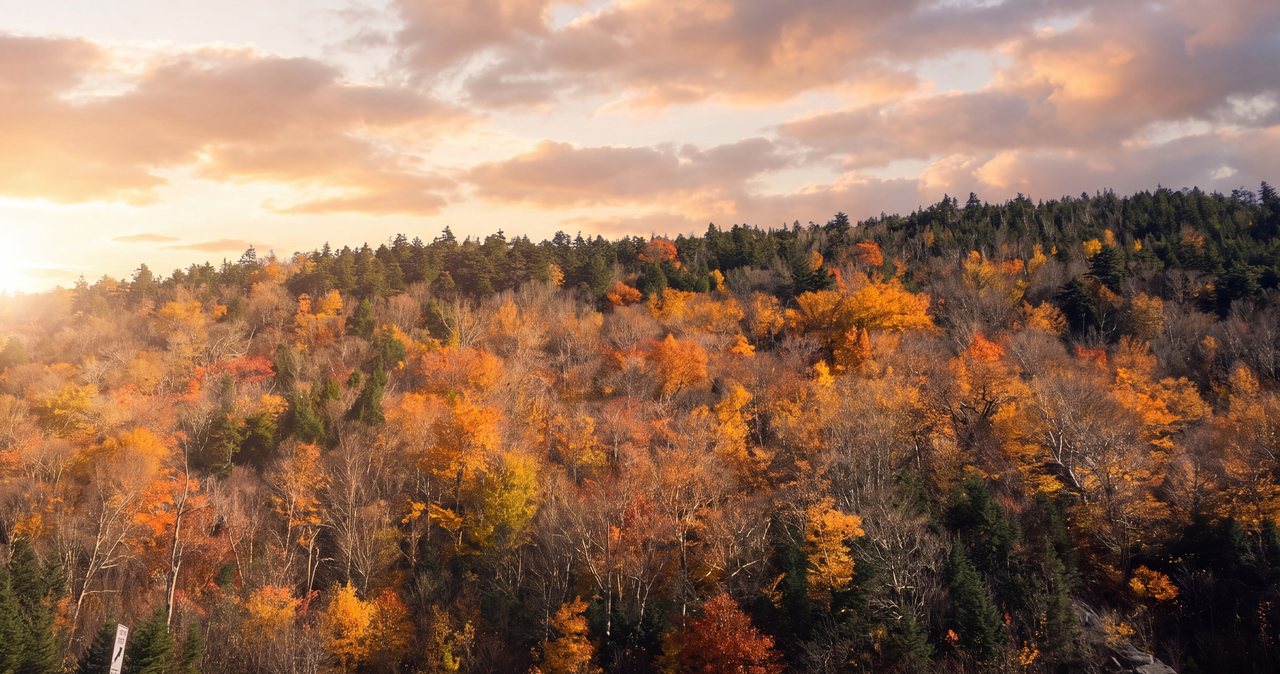
Autumn brings the rut, the moose breeding season, which runs from about mid-September into mid-October and peaks from late September into early October. During the rut, bulls travel more, call more, and pay far less attention to traffic than they do the rest of the year, so early fall can be one of the better stretches for a sighting. It is also the least predictable time to be near one. A rutting bull is single-minded and can turn aggressive, and both bulls and cows are covering more ground and crossing more roads than usual.
The complication for visitors is that the rut overlaps almost exactly with peak foliage. The same October evening that draws leaf-peepers onto every back road in the region is the evening the moose are least careful about those same roads. If you're driving the Kancamagus or Franconia Notch at dusk in early October, assume a moose could be around the next bend, keep your speed down, and give any animal you meet a wide berth. A bull in rut is not something to crowd for a photograph, and this is the season when people forget that.
Where people look near Lincoln
Two roads come up again and again in this corner of the state. Route 112 west out of North Woodstock, up through Kinsman Notch, runs alongside the Wild Ammonoosuc River under heavy tree cover, with wet ground close to the pavement, which is the combination that produces sightings. And Route 3 north out of Franconia Notch toward Twin Mountain, which is more open and easier to scan while you drive. Both are within a short drive of the house.
Closer still, the Kancamagus Highway begins at the end of our street and climbs east into the forest. The wet meadows, beaver flowages, and pond edges along its lower miles are classic moose ground at dusk, and you don't have to go far up it to be in good habitat. The Kanc runs thirty-four miles with no gas, no services, and no cell signal for its length, so treat even a short evening drive up it as a trip into the backcountry: full tank, someone who knows your plan, a real flashlight in the car.
All three are ordinary public roads with other cars on them. Watch the shoulders and the wet patches, get your passenger scanning the far side too, and if you stop, pull all the way off the pavement. A car halted in a travel lane at dusk on Route 112 is a real hazard, both for the traffic behind you and for you. If you'd like to know a road before you drive it in low light, our note on taking the Kancamagus slowly walks the daytime version, which is a sensible way to scout the pullouts and the wet spots while you can still see them.
Driving north to the Great North Woods
If seeing a moose is the entire point of the trip, and you're willing to drive for it, the best odds in the state are well north of here, up in the Great North Woods. The stretch of Route 3 north of Pittsburg toward the Canadian border is known as Moose Alley for good reason, and Route 16 through the Thirteen Mile Woods near Errol is a close second. Those are the roads where moose density is highest and traffic is thinnest, and where dedicated moose-watchers go when they want the strongest chance the state offers.
It is a long way, though. Pittsburg sits at the very top of New Hampshire, several hours' drive north of Lincoln, so this is an all-day expedition or an overnight, not a dusk loop from the lodge. Most guests do not need to go anywhere near that far to have a good evening close to home. But if you've come specifically for moose and want to stack the odds as high as they go, that's where to point the car. Our piece on drives beyond the Kancamagus covers how to think about the longer runs north if you want to fold one into the trip.
Driving safely at dusk
This is the part worth reading twice. A big adult stands about six feet at the shoulder and can weigh around a thousand pounds, and almost all of that mass rides high on long legs, well above the reach of your headlights. Its eyes don't throw light back the way a deer's do, so you cannot count on eye-shine to warn you. You can be very close before you see one at all.
What happens in a crash follows from that build. The bumper and the crumple zones, the parts of the car designed to absorb an impact, take out the animal's thin legs. The full weight of the body then comes over the hood and through the windshield and roof, into the space where the people are sitting. These collisions can seriously hurt the people in the car, not only the moose, which is why the state marks its highest-risk stretches with yellow moose-warning signs; where you see one, ease off and stay alert even if no animal ever shows.
The state's Fish and Game Department runs a campaign every spring called Brake for Moose, and its advice comes down to a few plain habits:
Drive the speed limit and no faster, scan both shoulders as you go, use your high beams whenever there's no oncoming traffic, and keep your speed low enough that you can always stop within the reach of your headlights. If a moose is in the road, slow down and stop, and wait until it has left before moving on.
If a moose is in your lane
A few things to add from driving these roads at dusk ourselves. Between dusk and full dark on Routes 112 and 3 and on the Kancamagus, drive well below the posted limit. If a moose is in your lane and you can't stop in time, brake hard in a straight line rather than swerving, because a swerve can send you into the oncoming lane or a tree. Where you see one moose, look for a second; a cow often has a calf with her, and it may still be back in the trees waiting to cross. And keep in mind that once you leave the town core there is no cell signal on most of the Kancamagus and only patchy coverage through the Notch, so download your maps and tell someone your route before you go. Our note on cell service and what to download covers exactly what to grab while you're still on the lodge's Wi-Fi.
What not to do
When you do find a moose, stay in the car. It sounds obvious, and every year people ignore it. Don't get out to close the distance for a better photograph. Don't put yourself between a cow and her calf, and never stand between a moose and the water it is walking toward. A moose can outrun a person without trying, and an animal that feels cornered or protective can do real harm with its front hooves. Give it room, keep the engine running so you can move off if you need to, and let it cross or wander away on its own time.
Reading its mood
A calm moose ignores you and goes about its evening. An agitated one tells you so: ears pinned back, the long hairs on its shoulders and neck standing up, licking its lips, or lowering and swinging its head. If you see any of that, you are too close, and the answer is to back off slowly in the car, not to hold your ground for one more frame. In the fall rut a bull can go from unbothered to charging faster than you'd expect. The encounters worth having are the quiet ones, where the animal never registers you as a problem at all. Photograph it through the glass with the window up, or simply watch, and let it be the one that decides the meeting is over.
If you'd rather someone else drove
If peering into the dusk at the wheel doesn't sound like a relaxing evening, hand the job to someone who does it every night. A guided moose tour puts you in a van or small bus with a driver who knows which bogs and salt pools have been productive that week, which is a real advantage over a first-timer guessing in the dark. Right here in Lincoln, Pemi Valley Moose Tours has been running nightly evening trips since 1999, leaving from Main Street a few minutes from the house, with a season that opens in mid-spring and runs into the fall. Farther north, Gorham Moose Tours runs evening wildlife trips out of Gorham, up in the North Country.
Both charge a fee, both are upfront that they still can't promise you an animal, and both are considerably safer than a visitor scanning the trees at speed on an unfamiliar road. They also free you to look instead of drive, which on a fall evening is no small thing. Message us and we'll point you to who is currently running; the operators change their schedules from year to year.
Planning a moose evening from the lodge
The easiest way to fold a moose evening into a stay is to not over-plan it. Pick a clear evening, aim for the last hour of light, and keep it loose. Have an early dinner in town first so you're fueled and not rushing; Basecamp Brewing, the brewpub at the base of Loon Mountain in Lincoln, keeps a full kitchen if you want something before you head out. Then drive one of the closer roads at dusk and be back within an hour or two. Franconia Notch is about 10 min north of us and Loon about 6 min east, so you're never far from a road worth scanning, and you can turn for home the moment you get cold.
Our area map lays out where these roads sit relative to the house, which makes it easy to pick something close for a first outing and judge the drive times. Dress a layer warmer than the thermometer suggests, keep a real flashlight and a full tank in the car, and go slow. Because we're an adults-only, quiet house in the middle of Lincoln, with the Kancamagus starting at the end of the street and keyless self check-in so you can come and go on the animal's schedule rather than a front desk's, a dusk moose drive fits the place well. Come back to a warm suite and a hot drink from the coffee lounge, and a cold evening outside becomes a good one.
When you're ready to pick dates, you can check availability and book direct, which is always the best rate with us. If moose are the reason for the trip, aim for a late-spring or early-fall stay, hold one clear evening loosely open, and reach out with any questions. We drive these roads too, and we're glad to point you toward wherever the sightings have been lately.
— Launchpoint Lodge, From the lodge