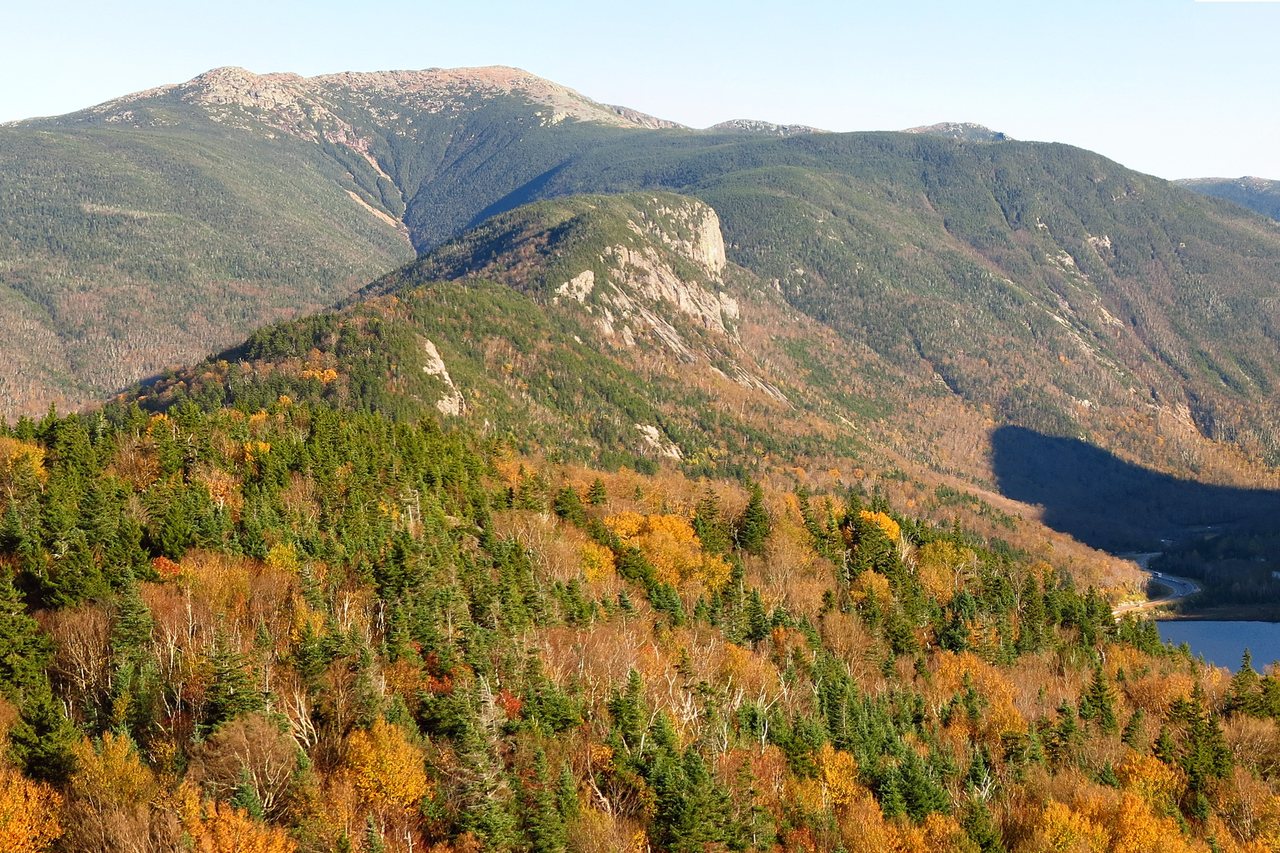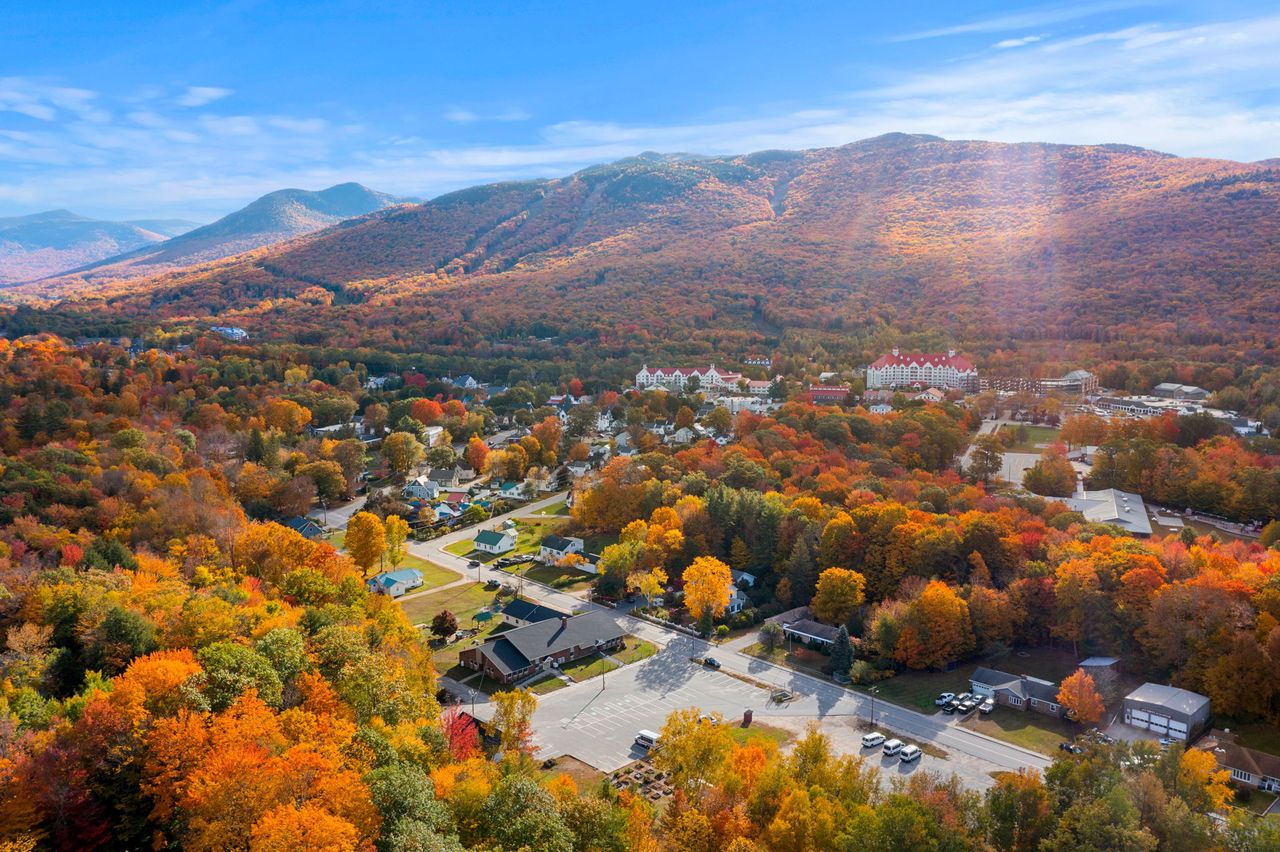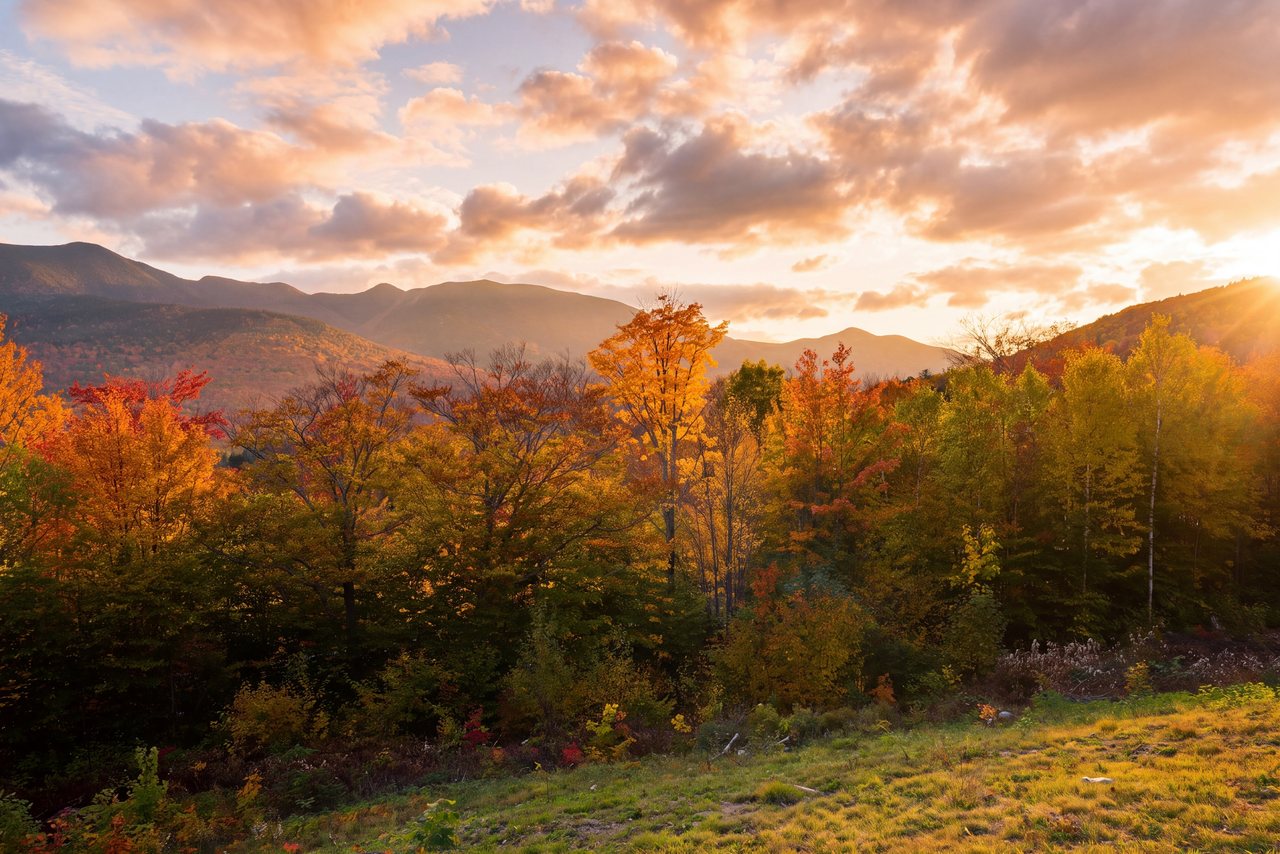
Lincoln is the second-largest town in New Hampshire by area, 131 square miles of it, and almost all of that is mountain: the Franconia Range, the whole Pemigewasset Wilderness, Mount Bond at 4,698 feet as the high point. The town itself is a strip along the Pemigewasset River and the Kancamagus, home to about 1,600 people in the last census, and it exists because of three things in turn: a lumberman's railroad, a paper mill and a ski mountain. Everything a visitor sees, from the flat trail into the wilderness to the condominiums at Loon's base, is a leftover of one of them.
This is the town's story as we tell it to guests who ask why a place this small has a mountain resort, a pulp-mill past and a wilderness the size of a county in its backyard. It runs from a colonial governor's paper grant to the collapse of the state's most famous rock face, with the lumber baron James Everell Henry in the middle of it, and it ends with where to go to see each chapter, because in Lincoln the history is mostly outdoors.
We have kept to the documented record: the town's own history, the histories of the East Branch and Lincoln Railroad, Loon Mountain's account of its founding, and the state's record of the Franconia Notch fight. Where the sources give a date, we give it; where they disagree, we say so.
1764: a grant to seventy men from Connecticut
In 1764 the colonial governor of New Hampshire, Benning Wentworth, granted 32,456 acres of mountain land to a group of about seventy investors from Connecticut, in the wave of township grants by which he carved up the province and collected his fees. He named it Lincoln for Henry Fiennes Pelham-Clinton, the ninth Earl of Lincoln and second Duke of Newcastle, a powerful English nobleman, Wentworth's relative by marriage and the comptroller of customs for the port of London under two Georges; the earl never saw it. The grant was a speculation on paper. Nobody lived in it for nearly twenty years.
Settlement began around 1782, after the Revolution, in the narrow river valley where the village is now, and the first federal census in 1790 counted twenty-two residents. For the next century Lincoln stayed a hill town of a few dozen farms and a sawmill or two, poorer and emptier than its neighbors, with the mountains behind it unowned in any practical sense and the notch to the north a rough road that the Franconia iron works and the first hotels used. The Old Man of the Mountain, discovered by surveyors in 1805, drew the first tourists past the town rather than to it.
1892: J. E. Henry buys the mountains
James Everell Henry, born in 1831, was the most ruthless and most successful of the lumber barons who stripped the White Mountains in the decades after the Civil War. He had already logged the Zealand valley to the north bare, with a railroad, a mill and a company village of his own, and watched fire follow his slash through it in 1886. In 1892 he bought roughly 100,000 acres of the East Branch of the Pemigewasset, the enormous roadless basin behind Lincoln, and moved his entire operation, workers, locomotives and all, south to the tiny village at its mouth. Lincoln became his company town: he owned the land, the mill, the store, the houses and the hotel, and he ran it as he pleased.
Henry is remembered for a line attributed to him, that he never saw a tree that meant more to him standing on a mountain than going under the saw, and for the clear-cutting that made it true. He is also remembered, by the people whose town he built, for building it: the mill, the houses, the church, the school and the railroad that made Lincoln a place with a payroll. Both memories are accurate. He died in 1912 and his sons sold the company five years later.
The East Branch and Lincoln Railroad, 1892 to 1948
To get the spruce out of the East Branch, Henry built a railroad into it: the East Branch and Lincoln, begun in 1892 and 1893 and extended for decades up every tributary valley, with logging camps numbered along the line and spurs that climbed to the headwalls. At its greatest extent it had about seventy-two miles of track including sidings, the largest logging railroad in New England, hauling logs to the Lincoln mill from what is now the heart of the Pemigewasset Wilderness. The last logging train ran in 1948, after the Parker-Young Company, which had bought the operation from Henry's heirs in 1917, finished the cut.
The railroad is the reason the wilderness trails around Lincoln are so flat. The Lincoln Woods Trail, the Wilderness Trail beyond it, the approach to Franconia Falls, the Bondcliff Trail's lower miles and the Zealand Trail all run on Henry's railbeds, with the ties still visible in places, the old trestle timbers at Camp 16 and Black Brook, and rusted iron in the woods a century after the last locomotive. Our hike guides to those trails point out the leftovers, and the Lincoln Woods Trail, when it reopens after its 2026 repairs, is the easiest place to walk the history.
1902: the mill, the hotel and the company town
In 1902 Henry opened a pulp and paper mill on the river in the middle of Lincoln, turning the East Branch spruce into paper on the spot instead of shipping logs south, and in 1903 he built the Lincoln House hotel beside it. The mill was the town's economy for the next seventy years, through four owners: the Henry family until 1917, the Parker-Young Company until 1946, the Marcalus Manufacturing Company until 1950, and the Franconia Paper Corporation, which ran it through the 1950s and 1960s and went bankrupt in 1971. Its smokestack and its smell defined Lincoln for three generations, and its closing left a mill town at the foot of a national forest with no mill.
The house the lodge occupies was built in 1902, the year the mill opened, a colonial on Pollard Road a few streets from the river in the town Henry was building; our story page tells its own history. The mill itself is gone, and its site along the river in the center of town has long since been redeveloped. What saved Lincoln from the fate of the other mill towns of the north was a decision made five years before the mill closed, on the mountain across the river.
1966: Sherman Adams opens Loon Mountain
Sherman Adams had been a lumberman in Lincoln before he was anything else, working for the Parker-Young Company in the 1920s, and after a career that took him to the governor's office in Concord and to the White House as President Eisenhower's chief of staff, he came back to the town and the mountain he knew. He and his partners began building a ski area on Loon Mountain in the spring of 1966 and opened it on December 27 that year, after eight months of construction, with twelve trails, two lifts and a gondola; five hundred people showed up with their skis on opening day without being invited. Adams served as Loon's president and general manager for nearly two decades, cruising the woods and running every detail, until his death in the fall of 1986 at eighty-seven.
Loon turned a dying mill town into a resort town within a decade of the mill's closing. The condominiums, the restaurants, the second homes and the summer gondola all follow from that December morning, and so does the existence of a six-suite inn on Pollard Road. Our Loon Mountain guide covers the mountain as it is now; the resort's own history page tells the founding story in Adams's own terms.
1988: the Franconia Notch Parkway
The other decision that shaped modern Lincoln was made in Concord and Washington over twenty years of argument. Interstate 93 was to run north through Franconia Notch, and the plans of the late 1960s called for a four-lane highway, or a tunnel, through the narrow pass under the Old Man of the Mountain. Conservation groups fought it as a threat to the Old Man's fragile ledge and the notch itself, and the fight stalled the road for years while the interstate ended at Lincoln. The compromise, worked out in the 1980s, was a two-lane parkway with a 45-mile-an-hour limit and gentler curves than the interstate standard, the only stretch of the interstate system built that way. It opened in June 1988, replacing old Route 3 through the notch.
The parkway is why the notch still looks like a notch, why the state park's lots sit beside the highway, why the Pemi Trail and the Recreation Path thread under it, and why Lincoln became the last full-service town before the mountains rather than a place the highway passed through. Our Franconia Notch State Park guide covers the park the fight preserved.
2003: the Old Man falls
Sometime in the night of May 3, 2003, the Old Man of the Mountain, the granite profile on Cannon Cliff that had been New Hampshire's emblem since its discovery in 1805 and the reason the parkway was built with such care, collapsed. Decades of cables and turnbuckles had held the ledges together; freeze and thaw won. The state built a memorial plaza at Profile Lake, dedicated in 2011 and completed in 2020, where steel profilers line up the missing face against the cliff. Our Old Man of the Mountain guide tells the whole story; it is 16 min from the lodge and the most visited piece of history in the valley.
The wilderness, the forest and the town today
The land Henry stripped is now the Pemigewasset Wilderness, about 45,000 acres of the White Mountain National Forest designated by Congress in 1984 as federal wilderness, roadless and unlogged, its spruce grown back over the railbeds. The national forest itself was created after the Weeks Act of 1911, the law that let the federal government buy cut-over eastern land for forests, championed by John Wingate Weeks of nearby Lancaster and driven in no small part by public anger at what Henry and his peers had done to the Whites and to the rivers below them. Lincoln's 131 square miles are mostly that forest now.
The town today is about 1,600 year-round residents and many times that on a February Saturday, a strip of Main Street along Route 112 between the interstate and the mountain, the Kancamagus starting at its edge, and a summer and winter economy that Henry would not have recognized and Adams would. The mill's smokestack is gone; the railroad's grades carry hikers; the mountain carries skiers; and the notch carries a two-lane road that half the state fought for.
Where to see the history
The Lincoln Woods Trail, when it reopens, and the Zealand Trail for Henry's railbeds and the flat walking they left; the Zealand Notch view and the state marker on Route 302 for the fires; the Old Man plaza at Profile Lake for the profile and the parkway; the New England Ski Museum at Cannon for the region's skiing story and Loon's history page for the mountain; the Franconia Iron Furnace for the industry that came before lumber; and the town's own walk along Main Street and the river, where the mill stood. The Upper Pemigewasset Historical Society in Lincoln and the Museum of the White Mountains at Plymouth State University, 30 min south, hold the photographs and the detail. And the 1902 house on Pollard Road is open every night, to guests.
Where to stay
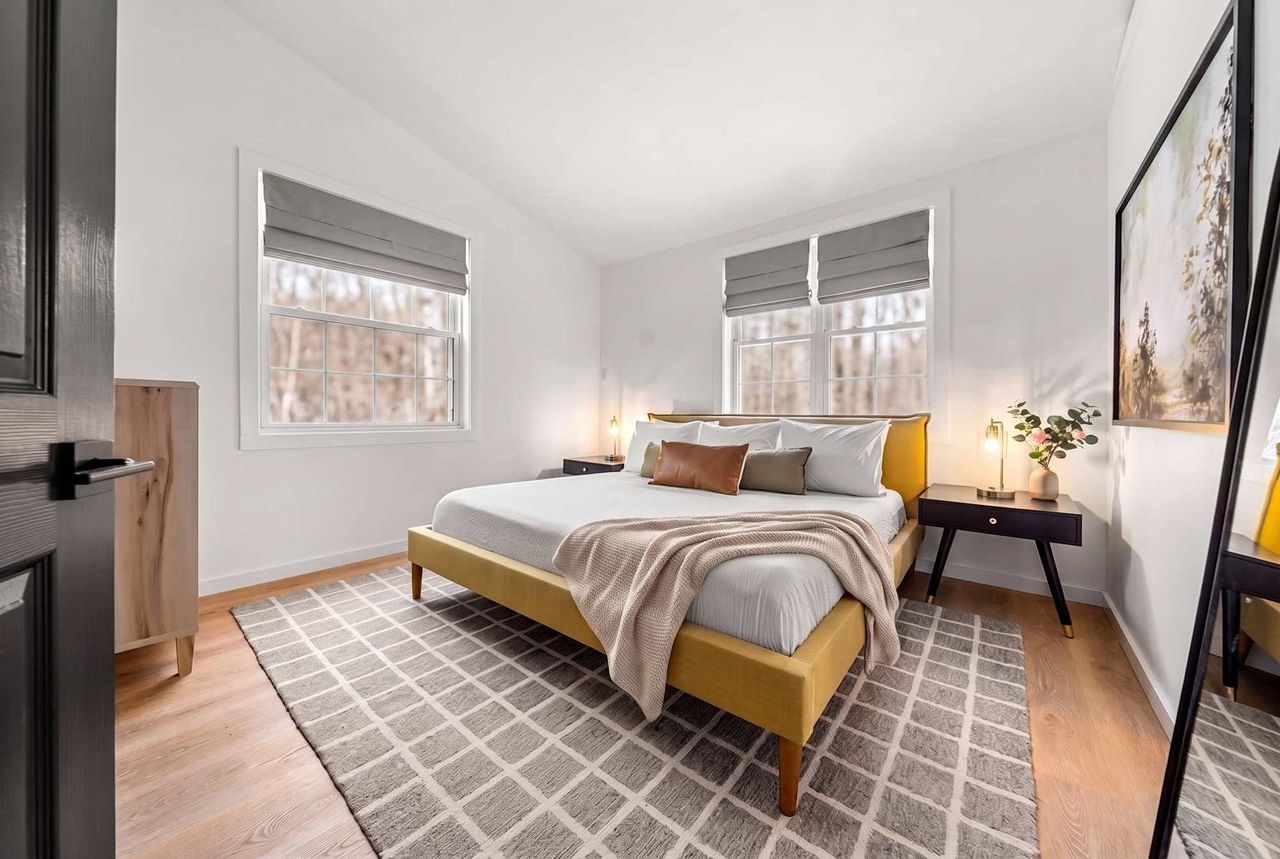
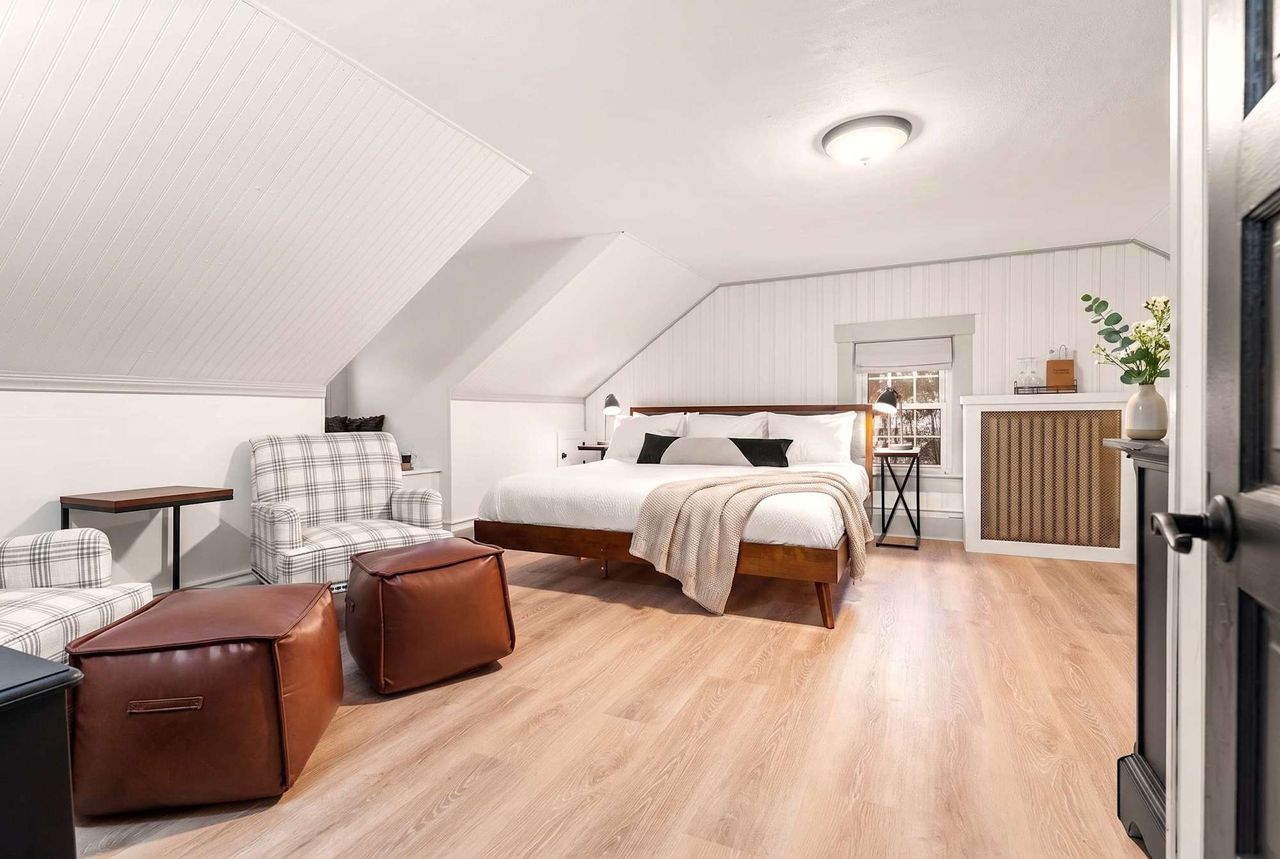
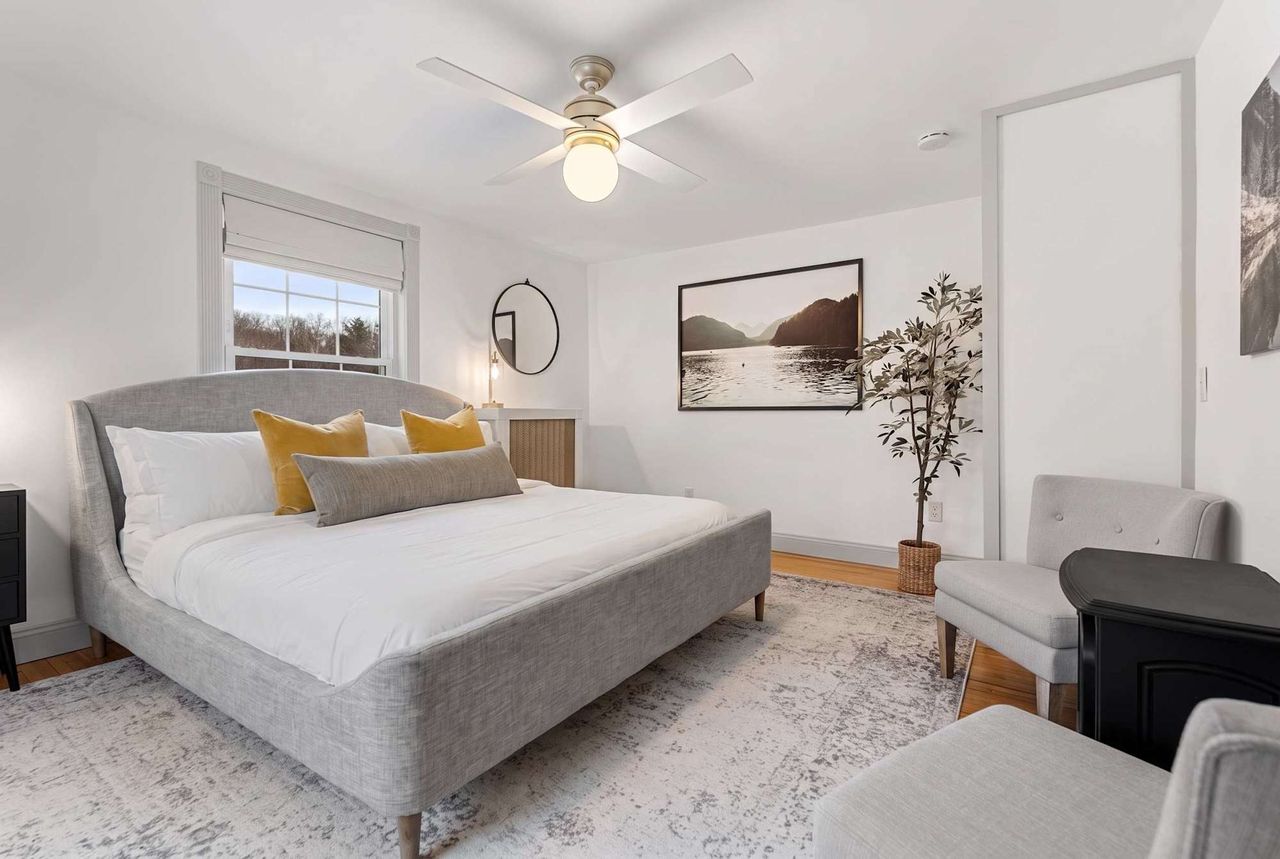
The lodge is itself a piece of the story: a colonial built in 1902 on Pollard Road, the year Henry's mill opened, a few streets from the river in the town he was building. Our story page tells how the house became an inn. From its door, the mill site and Main Street are a 5 min walk, Loon is 6 min, the Lincoln Woods railbed is 9 min, and the Old Man plaza is 16 min.
We keep a shelf of the local histories in the common lounge, including the railroad books that map every camp and spur in the wilderness, for guests who come back from the Lincoln Woods Trail asking what the rusted iron was.
Useful links
- Loon Mountain: the history of the resort
The founding story, Sherman Adams and opening day, as the resort tells it. - East Branch & Lincoln Railroad history (ScenicNH)
The camps, trestles and railbeds of Henry's railroad, with photographs of what remains. - White Mountain History: Zealand and J. E. Henry
Henry's first company town and the fires that followed his logging. - Our Old Man of the Mountain guide
The profile, its fall and the memorial plaza 16 min from the lodge. - Our Franconia Falls and Lincoln Woods guide
The walk along Henry's railbed, when the trail reopens after the 2026 repairs. - Our Zealand Falls guide
The other railbed walk, through the valley Henry logged first. - The story of the lodge
The 1902 house on Pollard Road and how it became an inn.
Sources & official info: scenicnh.com · uphsnh.org · loonmtn.com · gribblenation.org · whitemountainhistory.org
— Launchpoint Lodge, From the lodge