Ripley Falls is the rare White Mountains payoff that doesn't ask much of your legs and gives back a lot. From the trailhead at the end of Willey House Station Road in Crawford Notch, it's only about half a mile of climbing to stand at the foot of a hundred-foot ribbon of water sliding down a great angled slab of granite. Most people are up in 20 to 30 min. That short number is exactly why the falls deserve a careful guide rather than a breezy one: the brevity fools people into treating a steep, rooty, and slick trail like a stroll, and the beautiful sloping rock at the base is precisely the thing that has sent hikers off it with broken bones.
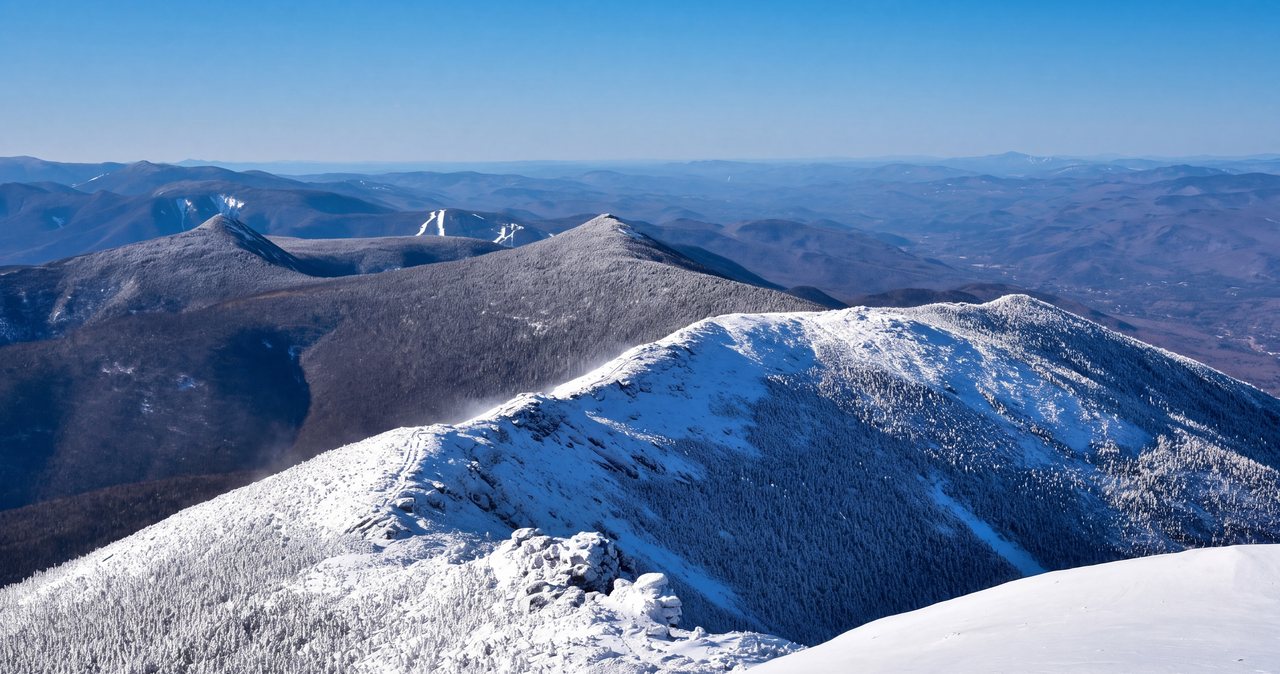
This is a Crawford Notch hike, not a Lincoln one, so from Launchpoint Lodge you're looking at roughly a 40 to 45 min drive up and over the height-of-land rather than a quick hop down the Kancamagus. That drive, though, is half the reason to go. You climb through Franconia Notch, run north to Twin Mountain, then turn back southeast on US 302 to descend one of the most dramatic mountain passes in the East, past the Mount Washington Hotel, Silver Cascade, and the Willey House before the small brown trailhead sign appears on your right.
Below you'll find the details that make the day easy: how the parking lot fills on a foliage Saturday, where the trail earns its elevation, why the slab deserves more care than the water, when Avalanche Brook is worth the trip and when it's a trickle, how to pair Ripley with Arethusa Falls (the tallest waterfall in New Hampshire, a few minutes down the road), and what changes once ice takes over in winter. We've listed the White Mountain National Forest and NH State Parks links at the bottom, so you can check current conditions before you leave your suite.
The short hike that punches way above its length
Ripley Falls is a classic case of a trail whose numbers understate it. The round trip runs roughly one to one-and-a-quarter miles, and the elevation gain is only about three hundred to three hundred twenty feet. On paper that reads like a warm-up. In practice, almost all of that gain is packed into the second half, so you go from an easy streamside walk to a steady, hands-occasionally-needed climb over roots and rock steps in the space of a few hundred yards. It is short, but it is not flat, and it is not smooth.
The route is a simple out-and-back with one junction. From the trailhead you start on the Ethan Pond Trail, which is also the Appalachian Trail here, and follow it for about two-tenths of a mile of gentle grade. Then you reach a signed junction and bear left onto the Arethusa-Ripley Falls Trail, which does the real climbing for the final three-tenths of a mile or so up to the base of the falls. Turn around at the water and reverse your steps. There's no loop unless you commit to the much longer Arethusa combination, which we cover further down.
Call it moderate, not easy, and you'll set the right expectation for the people you bring. Fit adults in decent shoes will find it straightforward and quick. Anyone shaky on wet rock, anyone in sandals, and anyone who treats 'short' as a synonym for 'casual' will find the descent in particular more demanding than they bargained for. The distance is beginner-friendly; the surface is not always.
Because it's so short and so rewarding, Ripley Falls is popular, and it draws a real cross-section of visitors, from serious peak-baggers passing through on the AT to families and cruise-ship-style day trippers who saw a photo. That mix is worth knowing about because it means the trail sees a lot of people who are underprepared for the steepness and the slab, which is part of why it has an injury history out of proportion to its size.
Getting there: the drive from Lincoln through Crawford Notch
Ripley Falls sits in Crawford Notch, on the far side of the White Mountains from Lincoln, so this is a drive with a payoff, not a 5 min errand. From the lodge the cleanest route is I-93 North through Franconia Notch to Exit 35, then US 3 North to the traffic light in Twin Mountain, where you turn right (east and then south) onto US 302. Follow US 302 into and through Crawford Notch. The whole trip is roughly thirty-five miles and about 40 to 45 min without stops.
You could also loop the long way around via the Kancamagus Highway to Conway and then north on Route 16 and 302, and it's gorgeous, but it's slower and it's not the way to go if the falls are your goal. Save the Kancamagus loop for a full scenic-drive day. For Ripley, the I-93-to-302 route over the top is the one.
The descent into Crawford Notch on US 302 is spectacular and heavily featured with landmarks. You'll pass the Omni Mount Washington Resort and Bretton Woods, then drop past the Highland Center at the top of the notch, the roadside ribbons of Silver Cascade and Flume Cascade, the historic Willey House site with its pond and seasonal snack bar, and finally, about a mile past the Willey House, a small brown US Forest Service sign on the right marking Willey House Station Road and the Ethan Pond / Ripley Falls trailhead.
That turn is easy to miss at speed, especially if you're rubbernecking at the cliffs, so slow down once you pass the Willey House. Willey House Station Road is a short paved spur, about three-tenths of a mile, that dead-ends at the parking lot. If you find yourself back down near Arethusa Falls Road you've gone a bit too far south; Arethusa is the next trailhead down and is very close by, which is exactly what makes pairing the two so easy.
Parking, the fee, and how the lot really behaves
The trailhead parking lot is at the very end of Willey House Station Road, a paved spur roughly three-tenths of a mile off US 302. It's a modest paved lot, on the order of fifteen to twenty vehicles, and that's the whole story: there is no large overflow area up top. On an ordinary weekday or a shoulder-season morning you'll have no trouble. On a summer weekend, and especially on a foliage Saturday in late September or early October, it fills early and stays full, with cars circling.
This is a fee area. Expect a five-dollar-per-day self-service parking fee, paid at the on-site kiosk or iron ranger; keep small bills in the car so you're not caught out. If you already carry a White Mountain National Forest recreation pass or the interagency America the Beautiful annual pass, which runs around eighty dollars a year, displaying it on your dashboard covers you at Forest Service fee sites. If you're going to hit several trailheads during your stay, the annual pass pays for itself fast; for a single visit, just bring the five dollars.
There is no restroom at the Ripley Falls trailhead and no water. Plan accordingly before you leave the lodge or stop at the Willey House site up the road, which has seasonal facilities. The lot has room for a few cars to turn around but not to idle-wait for a space, so if it's full your realistic options are to come back later, go do Arethusa first and swing by after, or park down at the base and walk up (more on that in the winter section, since that's exactly what winter forces).
One practical tip that saves foliage-weekend frustration: get here early. A trailhead this short and this famous is a first-stop for a lot of people, so arriving by mid-morning, or better yet at opening light, is the difference between a quiet visit and a crowded scramble for parking and a crowded slab at the top.
The trail, step by step
From the parking area, the trail leaves as the Ethan Pond Trail, which doubles as the Appalachian Trail through here, so you'll see the white AT blazes. The first stretch, about two-tenths of a mile, is the friendly part: a well-graded path through hardwoods and hemlock with only gentle rise, following the general line of Avalanche Brook off to your left. This is where the 'easy' reputation comes from, and if the whole hike were like this it would be a true beginner walk.
You then reach a clearly signed junction. Bear left onto the Arethusa-Ripley Falls Trail. This is where the hike changes character. Over the next roughly three-tenths of a mile the trail tilts up and gets to work, climbing steadily on a surface of exposed roots, embedded rocks, and rough stone steps. It's never technical in the rock-climbing sense, and you don't need gear, but you will use your hands here and there for balance and you'll be watching your feet closely. In wet conditions the roots turn to grease and the rocks get slick, which is the single most common way people get hurt on this trail, usually on the way down when gravity and fatigue conspire.
The climb is short-lived. Before long the trees open and the brook reappears, and you arrive at the base of the falls with the full hundred-foot cascade in front of you. There's a natural viewing and resting area at the bottom, with boulders and flat spots to sit, catch your breath, and take in the water. For most reasonably fit people the ascent takes 20 to 30 min; the descent is quicker but demands more care, not less.
Navigation is not a concern here. The trail is well marked, well worn, and short, with a single obvious junction, so route-finding isn't the challenge. The challenge is footing and judgment: respecting the steep pitch on the way down, and respecting the slab once you're up top. Treat the descent as the crux of the day and you'll do fine.
A note on trekking poles: they're useful on this trail despite its length. The combination of a short, steep, rooty grade and lots of hikers who don't usually carry poles means a lot of avoidable slips. If you have them, bring them, especially in shoulder season when leaves hide the roots and rocks.
The falls themselves: a hundred feet of angled granite
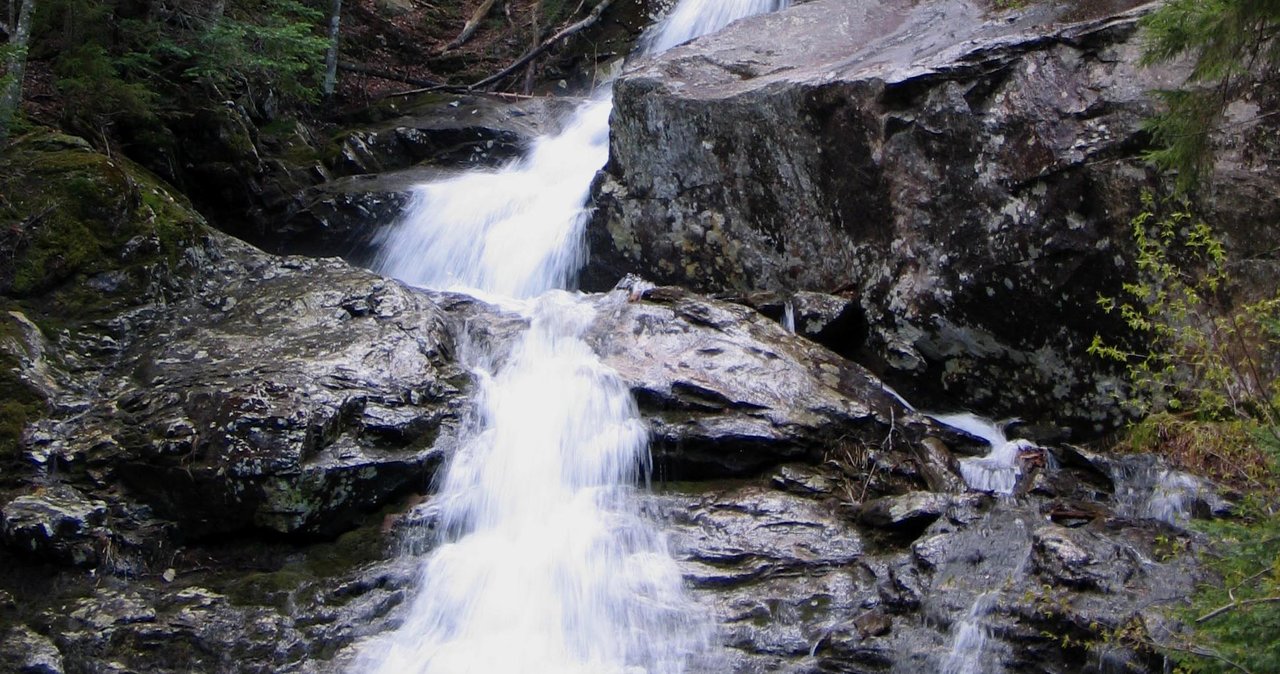
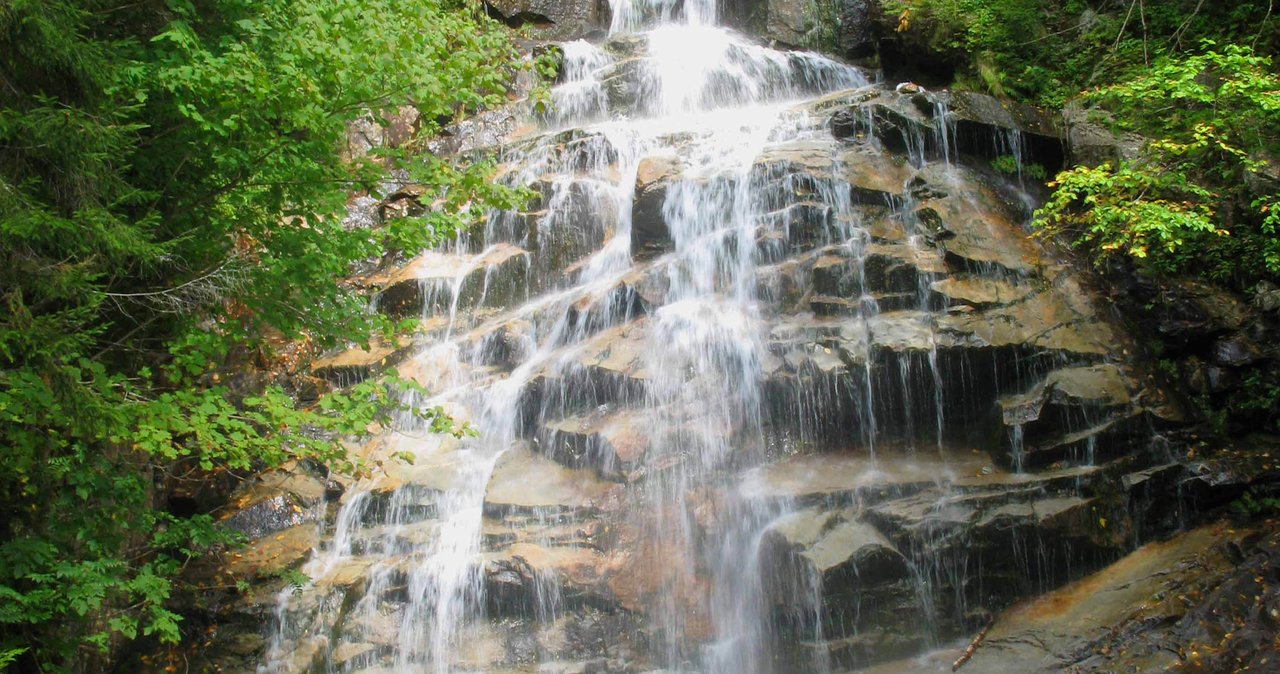
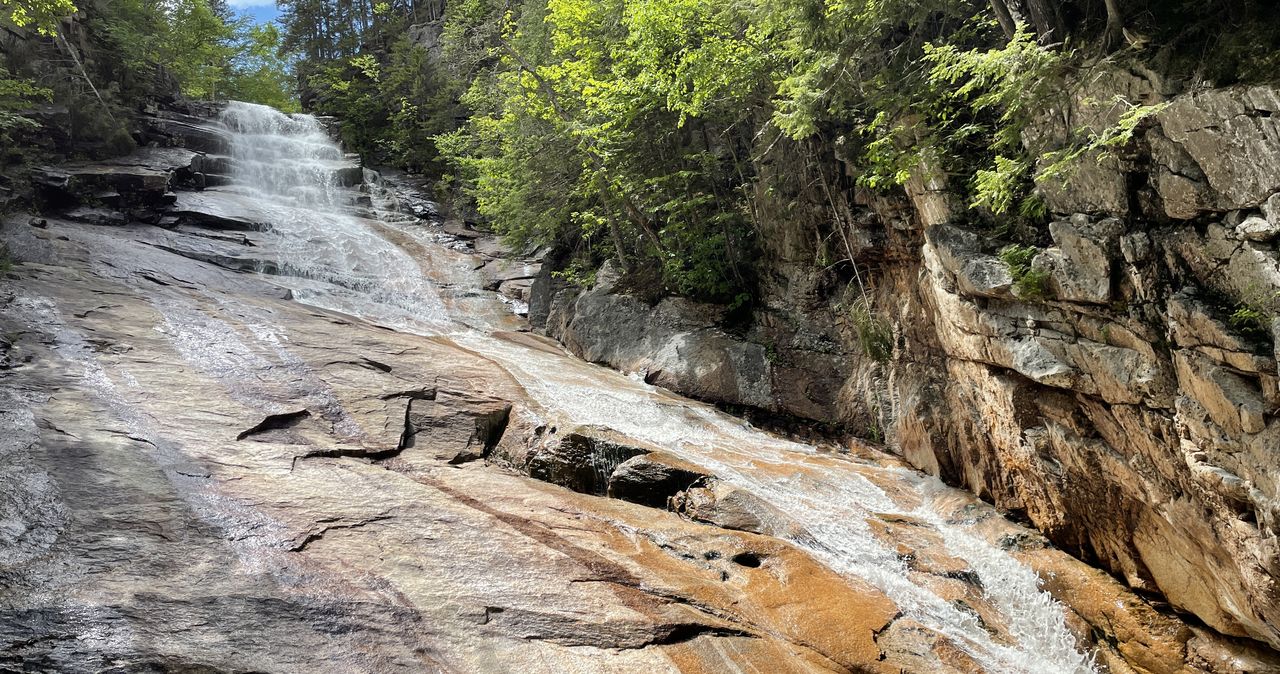
Ripley Falls is a sliding cascade rather than a free-falling plunge. Avalanche Brook pours down a broad, exposed sheet of granite that tilts at roughly a sixty-degree angle, spreading the water into a shining fan that drops about a hundred feet from top to bottom. That makes it one of the taller single cascades you can reach this easily anywhere in the White Mountains, and its character is very different from a vertical curtain like some of the region's plunge falls. Here the water and the rock are inseparable; the slab is the show.
The falls were reportedly named for Henry Ripley, who is credited with helping bring the spot to wider attention in the mid-1800s, back when it carried the wonderfully overwrought name 'Sylvan-Glade Cataract.' You don't need the history to enjoy it, but it's a reminder that this has been a beloved, visited place for well over a century, which is part of why the trail is so established and so worn.
Because it's a slide and not a plunge, Ripley's mood swings hard with the water level. In big flow, after snowmelt or heavy rain, the whole slab runs white and loud and impressive, throwing spray and filling the little amphitheater with sound. In a dry August, the same rock can show as a thin, quiet trickle over darkened stone, still pretty but a fraction of its full self. If the water is what you came for, timing matters, and we cover that below.
The base gives you a broad, open view of the entire cascade, which is unusual; at many waterfalls you only ever see part of the drop. Here you can take in the full hundred feet at once from a safe standing position at the bottom. That complete, head-on view is the reward, and it's available to anyone who makes the short climb, no scrambling required. Resist the temptation to improve on it by climbing the slab, because that's where the trouble starts.
The slab at the base of the falls
The one thing to know before you go: the beautiful sloping rock at the base of Ripley Falls is the part of the visit that calls for the most care, precisely because it looks so inviting. That great angled slab of granite is coated, in places, with a film of water and algae that is far slicker than it appears. It reads as walkable. It is not. People climb up onto it for a photo or to get closer to the water, lose their footing, and slide, and a slide on a sixty-degree wet rock face with no clean run-out is how you break an ankle, a wrist, or worse.
This isn't hypothetical. Every season, wet-rock slips on the trails around Crawford Notch lead to carry-outs, with volunteer rescue teams and Appalachian Mountain Club staff bringing down hikers who can't walk out on their own. A slip that would be a bruise on a flat sidewalk becomes an evacuation on a steep, remote slab miles from a road. The remoteness is the multiplier: help is not close, and cell coverage in the notch is unreliable at best.
So the rule at Ripley is simple and non-negotiable: enjoy the falls from the natural viewing area at the base, on level ground, and stay off the wet rock entirely. Do not climb the slab. Do not walk out onto the lower angled ledges to frame a shot. Do not let a child or a dog range onto the rock. The full head-on view from the bottom is already the best one, so there is nothing to gain by climbing higher on that face.
The trail itself compounds the message. Because the steep pitch just below the falls is rooty and often wet, the descent is where a large share of injuries happen, when tired legs and slick roots meet a downhill grade. Slow down going down. Test your footing. Use poles if you have them. The hike up lulls people into confidence; the hike down collects on it. Treat both the slab and the descent as the serious parts of an otherwise gentle day, and you remove almost all of the risk.
Water levels: when Ripley roars and when it whispers
Ripley Falls is entirely at the mercy of Avalanche Brook, and that brook is fed by snowmelt and rain rather than any large lake or reservoir, so its volume swings dramatically across the year. If you want the falls at their thundering best, the two reliable windows are spring snowmelt, roughly April into May, and the day or two after any significant rain in any season. In those conditions the slab runs full and white and the sound carries down the trail before you can see the water.
The flip side is high summer. A stretch of dry, hot weather in July or August can reduce Ripley to a modest flow, still photogenic and pleasant but nowhere near its peak. The hike is short and the setting is lovely either way, but if you're chasing a dramatic cascade, check whether it's rained recently and time your visit for the day after a good soaking.
One thing to keep in mind after a good rain: the same high water that makes the falls spectacular also changes the footing on the rock and the trail. In heavy flow, spray reaches farther across the slab and coats more rock, the base area is wetter and slicker, and any brook crossings or streamside footing run higher and faster. The best water and the worst footing arrive together. Go for the flow, but ratchet up your caution to match, and never wade or scramble near fast, high water.
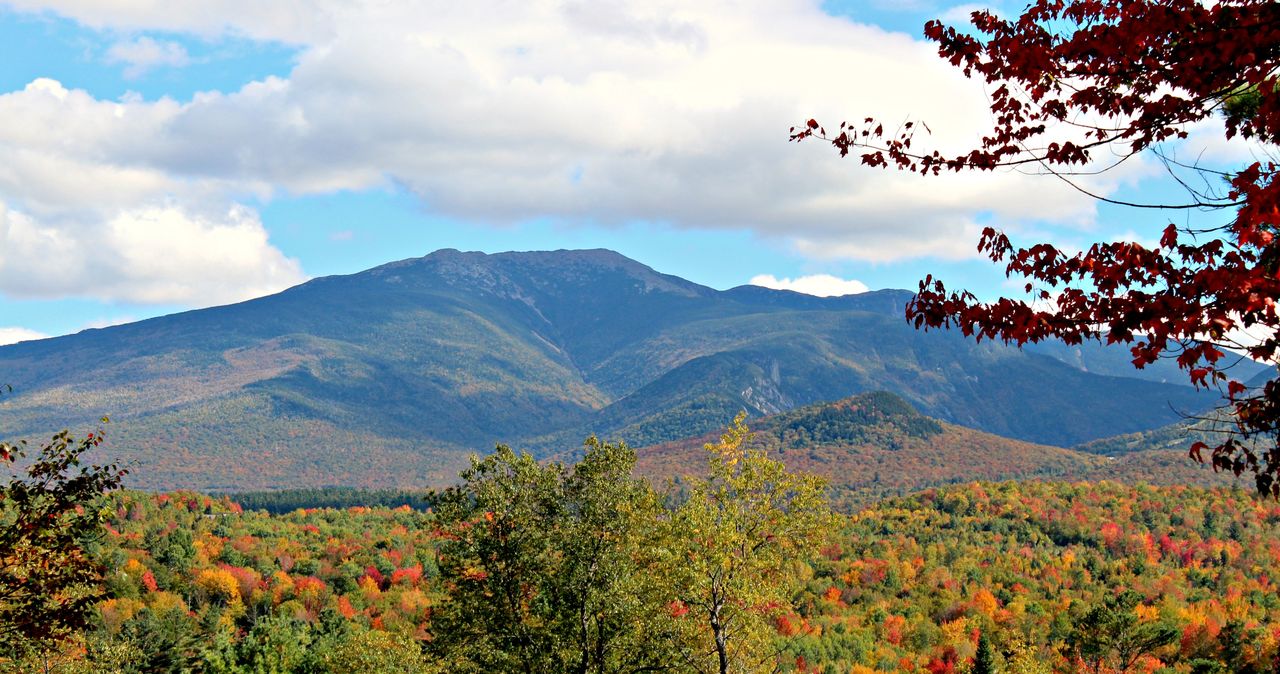
Foliage season, roughly the last week of September through the first week or two of October near the notch, is a separate reason to visit that has nothing to do with flow. The hardwoods framing the falls color up, the crowds arrive, and the parking lot fills early. Water levels in early fall are variable and depend entirely on recent rain, so manage your expectations on volume and come for the color and the setting as much as the cascade.
Combining Ripley with Arethusa Falls next door
Ripley's next-door neighbor is Arethusa Falls, which at roughly two hundred feet is the tallest single waterfall in New Hampshire, and the two are close enough that pairing them is the obvious move for anyone who's driven all the way to Crawford Notch. There are two very different ways to do it, and choosing the right one for your group matters.
The easy way is to treat them as two separate short hikes with a short drive between the trailheads. Do Ripley from Willey House Station Road, drive a few minutes south on US 302 to Arethusa Falls Road, and hike Arethusa as its own out-and-back of roughly two-and-a-half to three miles round trip to the base of the taller falls. This keeps each hike short and manageable, lets you bail on either one, and is by far the friendlier option for casual walkers and mixed-ability groups. You get both signature waterfalls in a half-day without committing to a big loop.
The ambitious way is the full loop that links them on foot. The Arethusa-Ripley Falls Trail connects the two falls over the shoulder of the terrain, and by combining it with the Frankenstein Cliff Trail you can make a loop that visits Ripley Falls, traverses to Arethusa Falls, and adds the dramatic clifftop views of Frankenstein Cliff along the way. That full circuit runs on the order of five to six miles with something like nineteen hundred to two thousand feet of elevation gain, which puts it firmly in the moderate-to-hard category and turns your half-day into a full one. It's a terrific hike for fit hikers, but it is a completely different undertaking from the 20 min stroll to Ripley alone.
If you only have the appetite for one waterfall, know that they offer different things: Ripley is the shorter, easier walk to a wide sliding cascade, while Arethusa is a slightly longer walk to a much taller, more classically dramatic drop. Doing both, in whichever style suits your legs, is the fullest way to experience this corner of Crawford Notch, and it's why so many trip plans treat the two as a matched set. Just don't let the loop's total mileage sneak up on you; check which version you're signing up for before you start.
Ripley Falls in winter
Winter transforms Ripley Falls completely, in beauty and in what it asks of you. The cascade freezes into a broad blue-and-white ice sheet that ice climbers come to climb, and the surrounding notch under snow is stunning. But winter also strips away every margin of safety the summer hike gives you, and it starts before you even reach the trail.
The first change is the road. Willey House Station Road, the paved spur to the trailhead, is not plowed in winter. That means the upper lot is inaccessible and you have to park down at the base near US 302 and walk up the road, adding roughly three-tenths of a mile each way to a hike that was already short. Be sure you're parking legally and well clear of the plow line on 302, and don't block the road.
The second change is the trail surface. That steep, rooty pitch below the falls becomes a hard-packed, icy chute. Traction devices are not optional here; you want microspikes at minimum, and you need to know how to use them. Bare boots on this grade in winter tend to slide, and the slab at the top becomes a sheet of ice with a long, steep run-out. The exact rock that you must stay off in summer becomes an active ice-climbing wall in winter, roped and technical, and it is absolutely not something to wander onto without ice-climbing gear and skills.
Winter also brings the usual White Mountain conditions: shorter daylight, deep cold and wind funneling through the notch, and even less reliable cell service. Dress in real layers, carry traction and a headlamp, tell someone your plan and turnaround time, and treat a 'short' winter hike with the same seriousness you'd give a longer one. Done right, Ripley in winter is one of the most beautiful easy destinations in the notch. Done casually, it's an ice-slip waiting to happen.
Bringing your dog
Dogs are welcome on the Ripley Falls trail, and it's a popular spot to bring one because it's short, shaded, and follows the brook. The rule that matters is leashing: keep your dog leashed and under control, both out of courtesy on a busy, narrow trail and, more importantly, for the dog's own safety at the top.
The slab that endangers people endangers dogs just as much, arguably more, because a dog doesn't read wet rock the way a person can be taught to. A leashed dog can't bolt onto the slick granite toward the water, and it can't slide down it. The base viewing area has plenty of room to let a dog rest and drink from calmer pockets of the brook; the angled rock face is exactly where you don't want a curious dog to wander. Keep the leash on right through the waterfall stop, not just on the walk up.
The brook gives dogs a good drink and a cool-down in warm weather, which is a nice bonus on the hike. Watch high water, though: a dog that plunges into fast, cold, spring-melt current near the base of a cascade is in the same trouble a person would be, so use the same judgment for them that you would for yourself, and keep them out of strong flow.
One planning note specific to where you're staying: Launchpoint Lodge is a pet-free property, so the trail being dog-friendly is useful mainly if you're a local or your dog is boarded elsewhere for the trip. If you're visiting from out of town and staying at the lodge, plan on this being a two-legged outing.
Swimming, wading, and the pool at the base
Ripley Falls collects into a modest pool at its base, and in low, calm summer water some people do wade in for a quick, cold dip. This is worth being real and precise about, because waterfalls in these mountains have a genuine drowning and injury history, and blanket 'go for a swim' advice gets people hurt.
Ripley is not a designated or supervised swimming area. There are no lifeguards, no depth markings, and no one watching. The water is snowmelt-fed and stays shockingly cold even in July, cold enough to trigger an involuntary gasp and a spike in heart rate the instant you go in, which is exactly how strong swimmers get into trouble in mountain pools. If you do get in, do it only when the water is low and calm, ease in rather than jumping, and never go under a cascade or near where the falling water hits.
The specific hazard at Ripley, again, is the slab, not the pool. The pool in low water is relatively benign; the wet rock you'd have to negotiate to reach and exit it is not. Keep your feet on level ground and gravel at the base, treat the sloping granite as off-limits, and don't try to climb up alongside the water to reach a 'better' spot to get in. There is no better spot worth the fall.
If a real swim is what your day is about, Ripley isn't the destination for it. The White Mountains have spots far better suited to cooling off, so it helps to know which is which: swimming at Rocky Gorge on the Kancamagus is prohibited and enforced, while lower, calmer river holes are legal and fine for wading. At Ripley, come for the cascade and the short hike; if you want water you can get into, plan a separate stop somewhere that's suited to it and calm enough to be safe.
Photography and the best light
Ripley Falls photographs beautifully, and its wide, angled slab makes it more forgiving than a narrow plunge because you can capture the entire hundred-foot drop head-on from level ground at the base. You don't need to climb or scramble to get the shot, which is fortunate, because you shouldn't. The full-frame view is available from exactly where it's safe to stand.
For the classic silky-water look, an overcast day is your friend. Bright, direct midday sun blows out the white water and throws harsh shadows across the slab; flat, even cloud light lets you drop your shutter speed and keep detail in both the water and the surrounding rock and foliage. If you're shooting on a phone, a lot of recent models have a long-exposure or 'live' mode that can approximate the effect handheld, though a small tripod or even bracing against a boulder helps.
The setting is at its most photogenic in two windows: high water in spring, when the slab runs full and dramatic, and foliage season in late September and early October, when the framing hardwoods turn. Combine either with soft light and you have the picture most people drive to Crawford Notch for. Just remember that spray drifts, so keep a lens cloth handy and keep your gear back from the wettest zone at the base.
Whatever you do, don't let the photo be the reason you break the one rule that matters here. The urge to step out onto the slab for a slightly closer or more dramatic frame is exactly what precedes the injuries this place is known for. The best shot and the safe position are the same position: on solid ground at the bottom, taking in the whole cascade at once.
What else is nearby in Crawford Notch
Because Ripley is such a short hike, it slots naturally into a fuller day in Crawford Notch, and the drive up US 302 is lined with worthwhile, low-effort stops. The most obvious pairing is Arethusa Falls, the tallest in the state, just down the road, which we covered above. Beyond that, the notch is one of the densest concentrations of roadside and short-walk scenery in New Hampshire.
Just up the road toward the top of the notch you'll pass Silver Cascade and Flume Cascade, two long, thin roadside waterfalls you can admire from pullouts without hiking at all, plus Saco Lake and the AMC Highland Center near the height-of-land. The historic Willey House site, about a mile north of the Ripley trailhead, has a pond, open lawn, a seasonal snack bar and gift shop, and interpretive history about the 1826 landslide that gave the notch its most famous tragic story. It's an easy, relaxed stop with the facilities the trailhead itself lacks.
For a bigger objective, Frankenstein Cliff, reached from near the Arethusa Falls trailhead, offers dramatic clifftop views over the notch and can be linked into the Arethusa-Ripley loop described earlier. The old railroad trestle beneath the cliff is a landmark in its own right. And the whole drive itself, the descent through the notch on US 302, is one of the great scenic drives in the region, so budget time to simply pull over and look.
Because Crawford Notch sits on the opposite side of the mountains from Lincoln, a smart plan treats Ripley as the anchor of a Crawford Notch day rather than a quick add-on to a Lincoln itinerary. Combine it with Arethusa, the roadside cascades, and the Willey House, and you've filled a satisfying half-to-full day in one of the most scenic corners of the White Mountains before heading back over the top to the lodge.
Safety & conditions
- The sloping rock slab at the base is the number-one hazard. It's coated with a slick film of water and algae, sits at roughly a 60-degree angle, and has no clean run-out below - people have slipped on it and been seriously injured. View the falls from level ground at the bottom and never climb onto the wet rock.
- The descent hurts more people than the climb. The steep, rooty pitch just below the falls becomes greasy when wet, and tired legs plus a downhill grade cause slips. Slow down going down, test your footing, and use trekking poles if you have them, especially on that rooty pitch.
- The plunge pool is snowmelt-cold year-round. Even in July the water can trigger cold-water shock - an involuntary gasp and heart-rate spike - the instant you enter. This isn't a lifeguarded swim area; if you wade at all, do it only in low, calm water and ease in.
- High water is a double-edged sword. Snowmelt and post-rain flow make the falls spectacular but also make the slab wetter and slicker and the brook higher and faster. Never wade, cross, or scramble near strong flow, and if Avalanche Brook is running brown and loud, admire it from a distance and don't get close.
- Winter changes everything. Willey House Station Road isn't plowed (park at the base and walk up), the steep pitch becomes an ice chute requiring microspikes, and the frozen slab is a technical ice-climbing wall - not a place to wander without ice gear and skills.
- Wear real footwear. No flip-flops or smooth-soled sneakers. The trail is short but rough, with roots, rock steps, and slick surfaces that demand actual tread.
- Cell service in Crawford Notch is unreliable. Tell someone your plan and expected return time, carry a headlamp in case you're slower than expected, and set a turnaround time - don't count on calling for help from the trail.
- Keep kids and leashed dogs off the slab and out of the current. Children and pets can't read wet granite the way adults can, so hold the leash and keep small hikers close at the base.
Where to stay for it
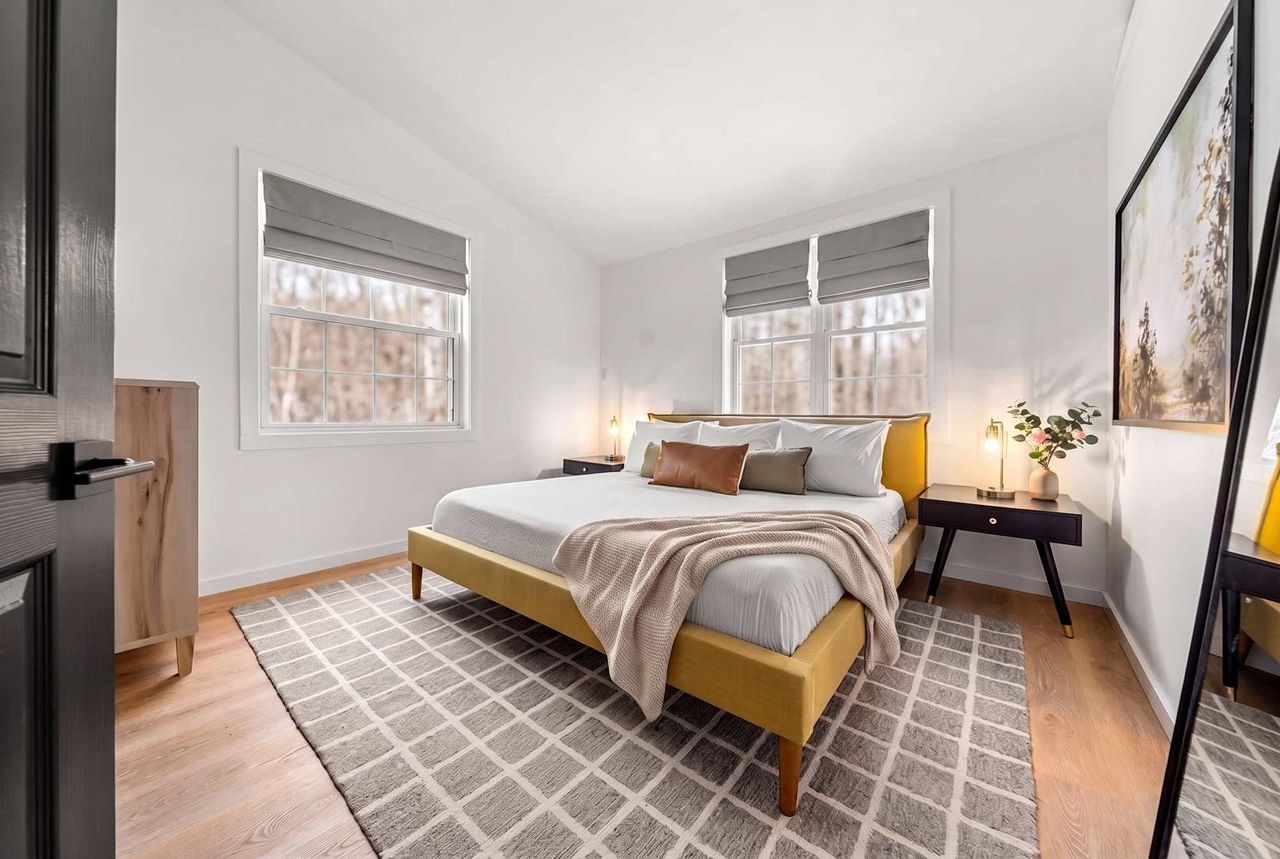
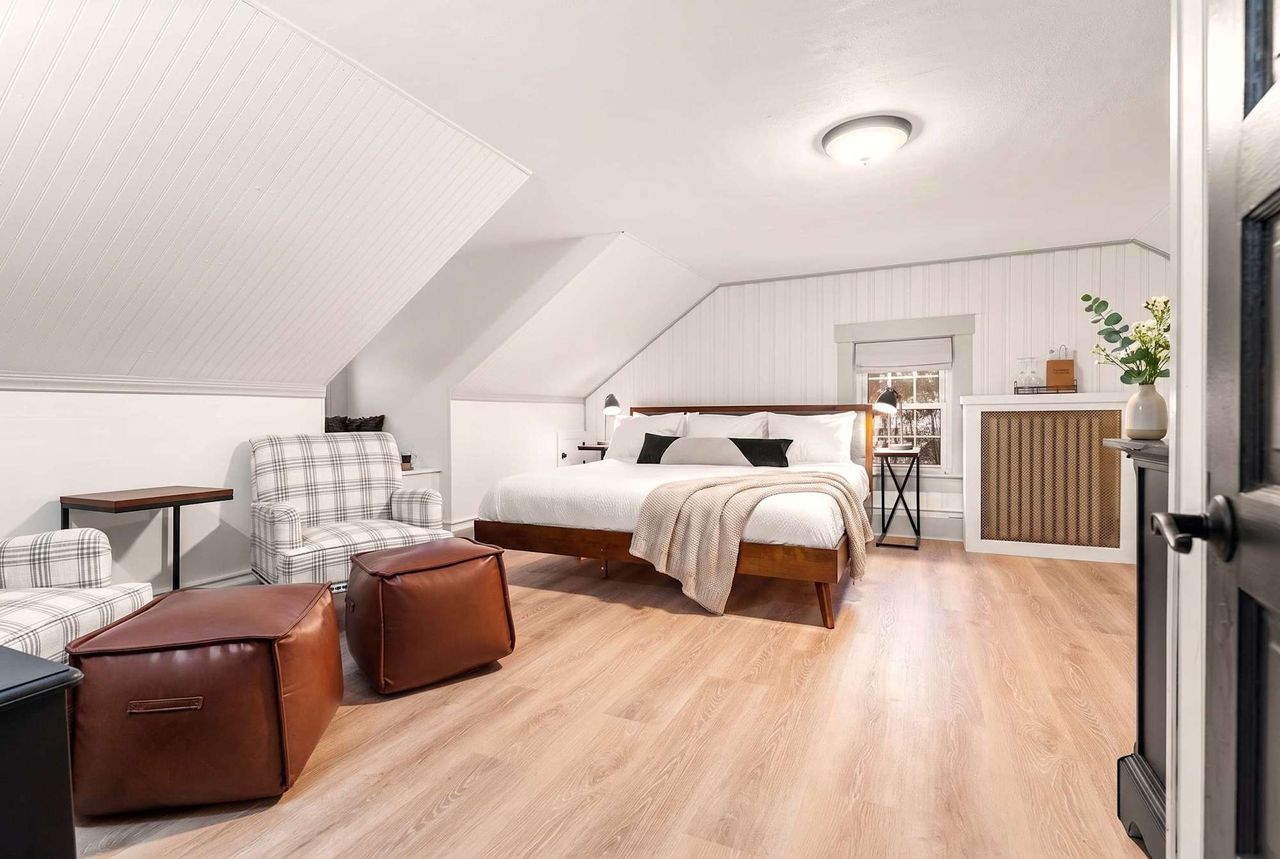
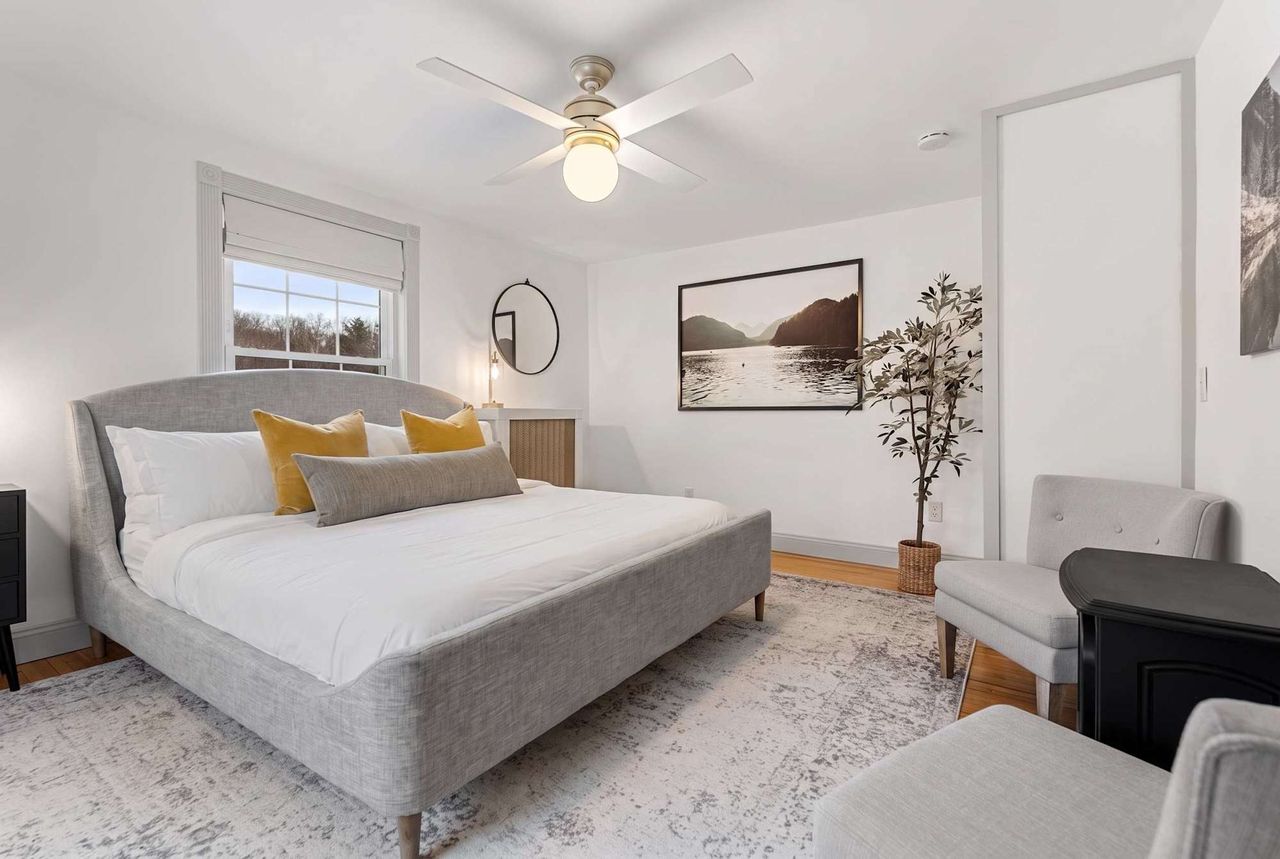
Ripley Falls is one of the few can't-miss waterfalls that sits on the Crawford Notch side of the mountains rather than the Lincoln side, so from Launchpoint Lodge it's a proper little road trip rather than a quick hop down the Kancamagus. Figure on about 40 to 45 min each way: north on I-93 through Franconia Notch, over to Twin Mountain on US 3, then southeast on US 302 to descend one of the most dramatic mountain passes in the East. The drive itself, past the Mount Washington Hotel and the roadside cascades of the notch, is half the reason to go.
Because the hike is so short and the neighborhood is so rich, this makes an ideal centerpiece for a full Crawford Notch day: pair Ripley with Arethusa Falls a few minutes down the road, add the roadside stops and the historic Willey House, and you've filled a satisfying half day before an unhurried drive back over the top. It suits the pace of an adults-only stay perfectly - a real waterfall for a modest walk, then a quiet evening back in your suite with your feet up. Check the current road and water conditions before you set out.
Sources & official info: fs.usda.gov · alltrails.com · blog.nhstateparks.org · trailfinder.info · nhfamilyhikes.com · world-of-waterfalls.com
— Launchpoint Lodge, From the lodge